TensorFlow & PyTorch (ML Frameworks)
TensorFlow & PyTorch (ML Frameworks)
TensorFlow and PyTorch are two of the most widely used deep learning frameworks, both offering powerful tools for building and deploying machine learning models.
However, they have different design philosophies and use cases.
TensorFlow
TensorFlow is an open-source machine learning framework developed by Google Brain. It is widely used for building and deploying machine learning models, especially in production environments. TensorFlow is known for its scalability and ability to handle complex workflows.
Key Features of TensorFlow :
Symbolic Computation and Static Graphs : TensorFlow uses a static computation graph, which means that the graph is first defined and then executed within a session. This allows for optimization techniques like distributed training across multiple machines.
TensorFlow 2.x and Eager Execution : TensorFlow 2.x introduced eager execution, enabling dynamic computation graphs, similar to PyTorch. This makes TensorFlow more flexible and easier to use.
High-Level API (Keras) : Keras, integrated into TensorFlow, serves as a high-level API that simplifies the process of creating neural networks. Keras abstracts much of the complexity of TensorFlow, making it easier to build models quickly.
Production-Ready : TensorFlow is built for production, with tools like TensorFlow Serving for deploying models, TensorFlow Lite for mobile and embedded devices, and TensorFlow.js for running models in the browser.
Distributed Training : TensorFlow supports distributed training across multiple GPUs and TPUs, allowing for large-scale model training.
Visualization (TensorBoard) : TensorFlow includes TensorBoard , a powerful tool for visualizing training metrics, model graphs, and more. It helps track model performance during training.
Use Cases for TensorFlow :
Enterprise Machine Learning : TensorFlow’s scalability and production tools make it ideal for large-scale deployments.
Mobile and Edge ML : With TensorFlow Lite, models can be optimized and deployed on mobile and IoT devices.
Research and Industry : TensorFlow is used in research and industry for tasks such as image recognition and NLP.
PyTorch
PyTorch , developed by Facebook’s AI Research lab (FAIR), is known for its dynamic computation graphs and ease of use. It has become highly popular among researchers and developers due to its flexibility and Pythonic design.
Key Features of PyTorch :
Dynamic Computation Graphs (Define-by-Run) : PyTorch allows dynamic computation graphs, meaning the graph is built on the fly as operations are executed. This makes it more flexible, especially when working with models that need to change during runtime.
Ease of Use and Pythonic Code : PyTorch is designed to be intuitive for Python developers. Its API feels natural and integrates seamlessly with Python libraries like NumPy.
Autograd : PyTorch includes the Autograd module for automatic differentiation, simplifying the process of computing gradients and implementing backpropagation.
Model Flexibility : PyTorch is favored for research because of its flexibility. It allows for real-time changes to model architectures, making it ideal for experimentation.
Native GPU Support : PyTorch supports CUDA for GPU acceleration, enabling fast model training and inference.
TorchScript for Production : PyTorch has introduced TorchScript to bridge the gap between research and production, allowing dynamic models to be converted into a form that can be optimized and deployed.
Use Cases for PyTorch :
Research and Academia : PyTorch is widely used for research due to its flexibility and dynamic computation graph.
NLP and Computer Vision : PyTorch is often used in tasks like NLP, image classification, and object detection.
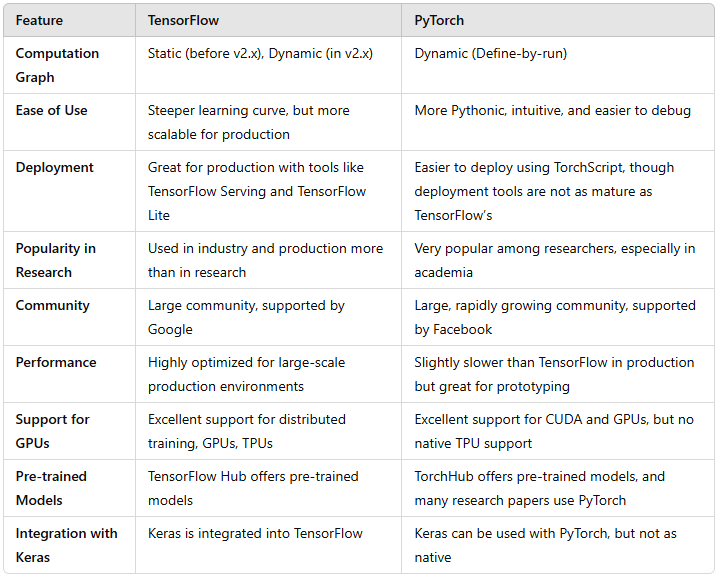
TensorFlow vs PyTorch