L5: Foundation Models (FMs)
L5: Foundation Models (FMs)
22:48
Foundation Models
What Are Foundation Models?
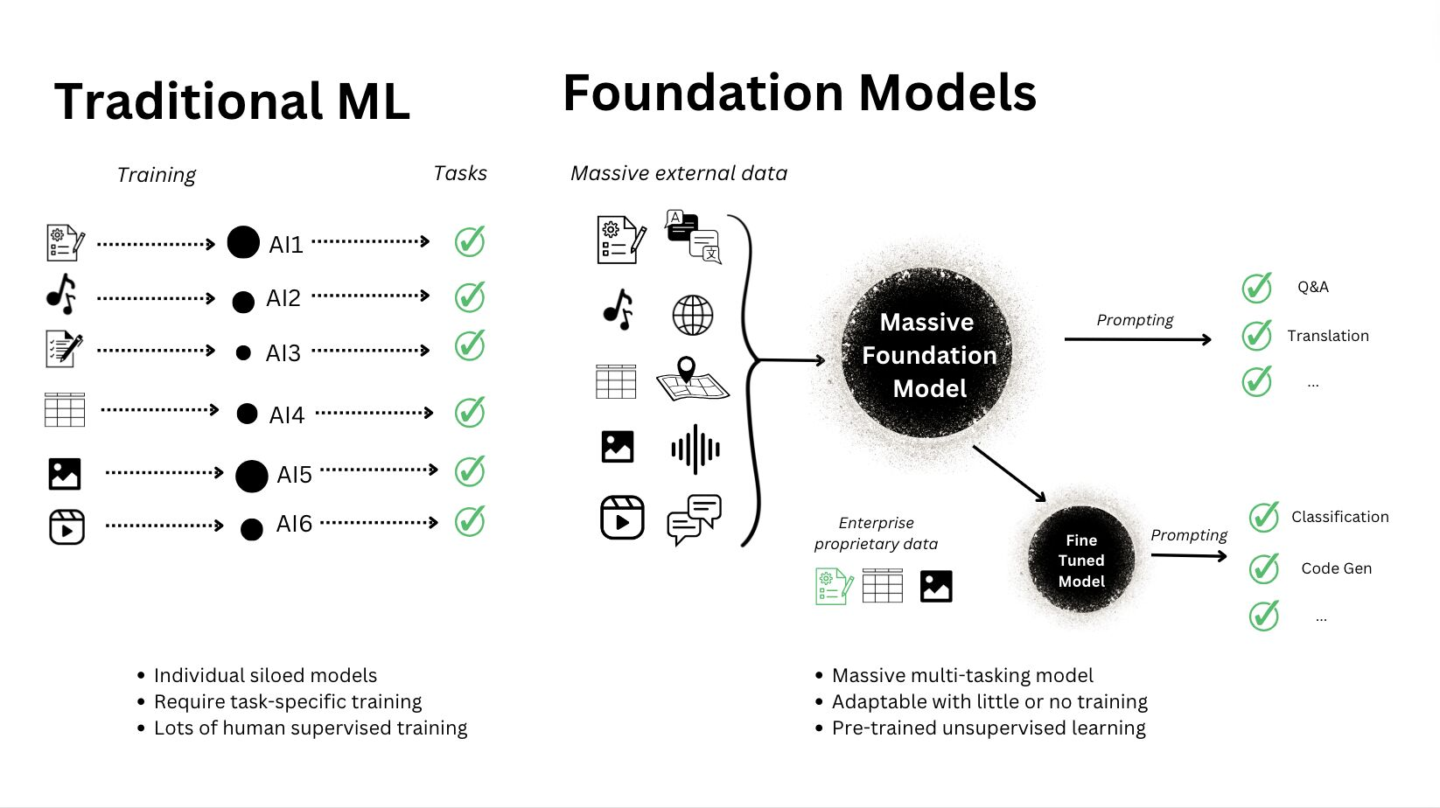
Foundation Models (FMs) are large AI models trained on massive datasets (text, images, code, audio, etc.) that can perform many different tasks instead of just one.
Think of a Foundation Model as a strong base or foundation on which many AI applications are built.
👉 Instead of training a new AI model from scratch every time, developers reuse a foundation model and adapt it for different tasks.
In simple terms:
One large AI model → Many different applications
Why Are They Called “Foundation” Models?
They are called foundation models because:
They are trained once on very large and diverse datasets
They can be reused across many applications
Many AI systems are built on top of them
📌 Example
A single foundation model can be used for:
Chatbots
Text summarization
Image generation
Code generation
Examples of Foundation Models
Some popular foundation models include:
GPT – Used for text generation and chatbots
BERT – Used for understanding text meaning
DALL·E – Used for image generation
Stable Diffusion – Used for creating images
PaLM / Gemini – Used for multi-task AI systems
Core Capabilities of Foundation Models
1. Multi-Task Learning
Foundation models can perform multiple tasks using the same model.
Examples:
Answer questions
Translate languages
Summarize documents
Generate images or text
2. Transfer Learning
Foundation models can be fine-tuned for specific tasks using smaller datasets.
Example:
A general language model can be further trained for:
Medical text analysis
Legal document understanding
Customer support conversations
3. Context Understanding
Foundation models understand context and meaning , not just keywords.
Example:
They understand the difference between:
“Bank” as a financial institution
“Bank” as a river bank
4. Scalability
Foundation models continue to perform well even when:
Data grows
Users increase
Tasks become more complex
This makes them suitable for enterprise-level applications.
5. Generative Ability
Many foundation models can create new content , such as:
Text
Images
Audio
Code
This is why they are widely used in Generative AI systems.
Where Are Foundation Models Used?
Foundation models power many real-world applications.
1. Chatbots & Virtual Assistants
Foundation models power intelligent chatbots that can:
Answer user questions
Hold natural conversations
Understand user intent
Examples:
Customer support chatbots
AI assistants like ChatGPT, Copilot, and Gemini
HR or IT helpdesk bots
Why it works well:
They understand language and context effectively.
2. Content Creation & Writing
Foundation models can generate human-like content such as:
Blog posts
Emails
Marketing content
Product descriptions
Examples:
Writing LinkedIn posts
Drafting emails
Creating marketing copy
Benefit: Saves time and increases productivity.
3. Code Generation & Developer Assistance
Foundation models trained on programming data can:
Generate code snippets
Explain existing code
Fix bugs
Convert code between languages
Examples:
GitHub Copilot
AI coding assistants
Benefit: Developers write code faster with fewer errors.
4. Search & Question Answering
Foundation models improve search by understanding meaning instead of just keywords.
They can:
Answer questions from documents
Summarize long reports
Power enterprise search systems
Examples:
Company knowledge search
Legal or medical document Q&A
This is often combined with RAG (Retrieval-Augmented Generation).
5. Image & Media Generation
Some foundation models work with images, audio, and video.
They can:
Generate images from text
Edit photos
Create design ideas
Examples:
AI image generators
Logo and artwork creation
Benefit: Helps designers and content creators.
6. Education & Learning
Foundation models are used to:
Explain complex topics in simple language
Act as AI tutors
Generate quizzes and summaries
Examples:
Personalized learning platforms
AI teaching assistants
Benefit: Learning becomes more interactive and personalized.
7. Healthcare & Medical Assistance
In healthcare, foundation models help with:
Medical text analysis
Clinical documentation
Research summarization
Examples:
Assisting doctors with reports
Analyzing medical research papers
⚠️ These systems assist doctors, not replace them.
8. Business & Enterprise Automation
Foundation models help businesses by:
Automating repetitive tasks
Analyzing large documents
Improving decision support
Examples:
Invoice processing
Report analysis
Knowledge assistants
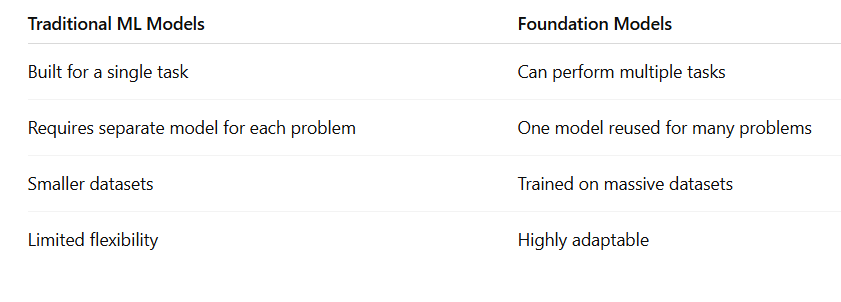
Foundation Models vs Traditional ML Models
Why Foundation Models Are Important
Foundation models:
Reduce development time
Lower training costs
Enable powerful AI applications
Act as the backbone of Generative AI and AI agents
They are the building blocks of modern AI systems.
Summary
Foundation Models are large, reusable AI models
They are trained on massive datasets
They can perform many different tasks
They power LLMs, Generative AI tools, and AI agents
Most modern AI applications are built on top of foundation models
References / Related
- Foundaiton Models -> https://humanloop.com/blog/foundation-models