CNN, DNN, RNN, LSTM, ANN ... Neural Net. Types
CNN, DNN, RNN, LSTM, ANN ... Neural Net. Types
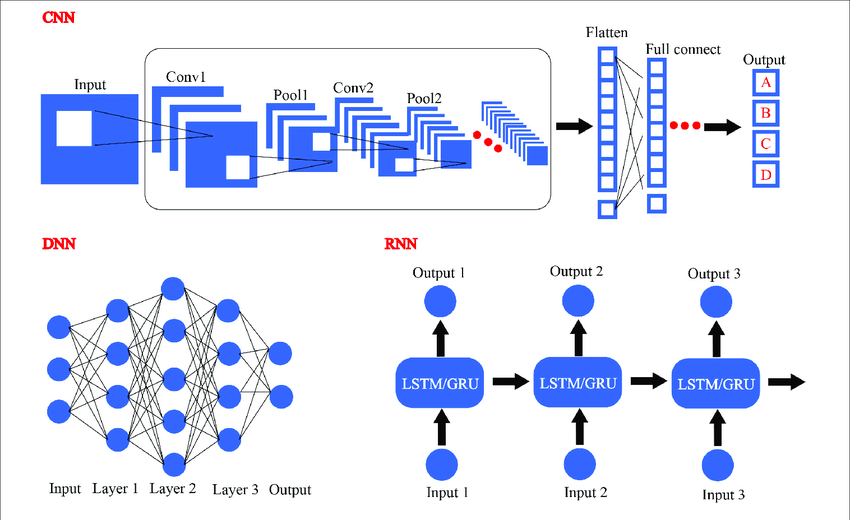
CNN , DNN ,RNN , and LSTM are all types of Artificial Neural Networks (ANN) used in deep learning (DL) , a subfield of machine learning (ML), which in turn is part of artificial intelligence (AI).
These networks are designed to model complex patterns in data, but they specialize in different types of tasks and data structures.
Here's an overview of each & comparison:
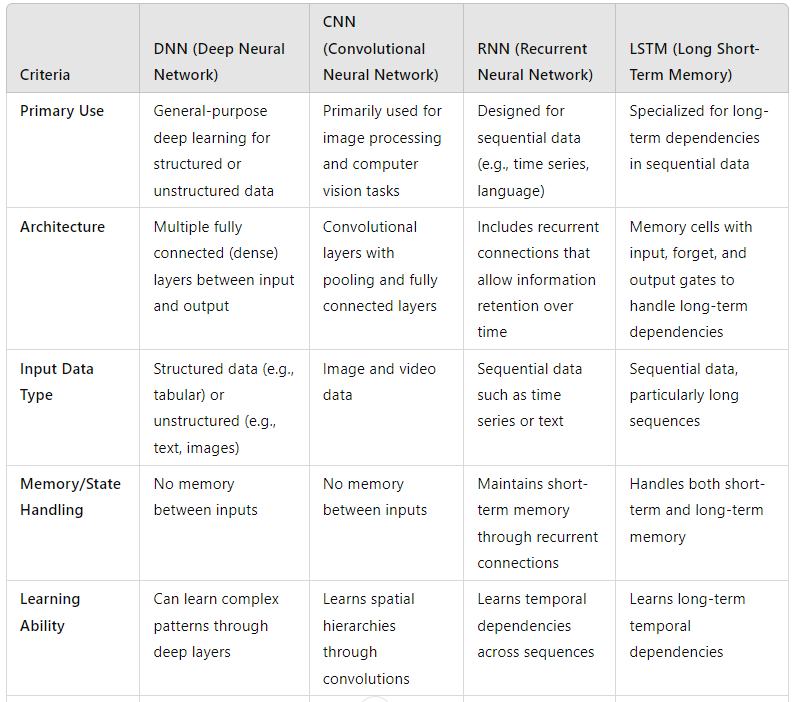
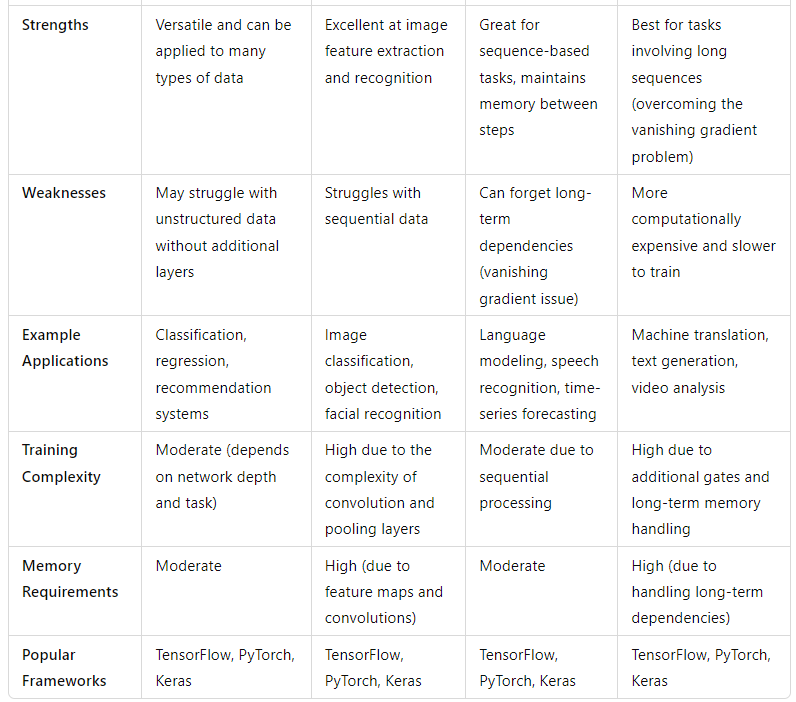
CNN (Convolutional Neural Network):
Purpose: Primarily used for image processing tasks such as image classification, object detection, and facial recognition.
Architecture: Uses convolutional layers to automatically extract features like edges and textures from images. These layers are followed by pooling layers and fully connected layers.
Applications: Image recognition, video analysis, medical imaging, and self-driving cars.
DNN (Deep Neural Network):
Purpose: General-purpose deep learning model for structured or unstructured data. It’s a broader category that includes all deep learning models with multiple layers.
Architecture: Consists of multiple fully connected layers (dense layers) between the input and output. The depth allows DNNs to model complex relationships in data.
Applications: Structured data classification, regression tasks, and any deep learning task that doesn't require specialized layers like those in CNNs or RNNs.
RNN (Recurrent Neural Network):
Purpose: Designed for sequential data like time-series data or text where the order of data points matters.
Architecture: RNNs have loops within the network that allow information to persist over time, making them effective for handling sequences. Each node passes information to its successor while maintaining a memory of previous computations.
Applications: Language modeling, time-series forecasting, and machine translation.
LSTM (Long Short-Term Memory):
Purpose: A special type of RNN designed to remember long-term dependencies in sequence data, solving issues like vanishing gradients faced by traditional RNNs.
Architecture: LSTMs use a more complex structure involving gates (input, forget, and output gates) to control the flow of information, enabling long-term memory retention.
Applications: Text generation, speech recognition, machine translation, and any task involving long sequences of data.
Where Do They Fall Under:
All these models fall under the umbrella of Artificial Neural Networks (ANNs) , which in turn are a part of deep learning. Here's a hierarchical breakdown:
- Artificial Intelligence (AI):
The broader field of creating machines that can perform tasks that typically require human intelligence.
- Machine Learning (ML):
A subset of AI that focuses on enabling machines to learn from data and improve their performance over time.
- Deep Learning (DL):
A subset of ML that uses artificial neural networks with multiple layers to model complex patterns in data.
- Artificial Neural Networks (ANNs):
A family of models inspired by the human brain, consisting of layers of interconnected neurons. Examples include:
 * **DNNs:** General deep networks with multiple layers.

 * **CNNs:** Designed for tasks involving images.

 * **RNNs:** Designed for sequential data.

 * **LSTMs:** A special form of RNN for handling long-term dependencies.
Summary:
CNNs are specialized for image and video data.
RNNs are for sequential data like time series or text.
LSTMs improve upon RNNs by handling long-term dependencies.
DNNs refer to any deep network with multiple layers but lack the specific structure of CNNs or RNNs.
These networks are all types of deep learning models under the larger umbrella of machine learning and artificial intelligence.