Hallucination
Hallucination
What is Hallucination in AI, ML, and Gen AI? 🤖💭
In the world of Artificial Intelligence (AI) , Machine Learning (ML) , and Generative AI (Gen AI) , hallucination refers to the AI generating information that is incorrect, misleading , or completely made-up. It happens when the AI model "imagines" details or answers that are not based on real data or facts.
Definition :
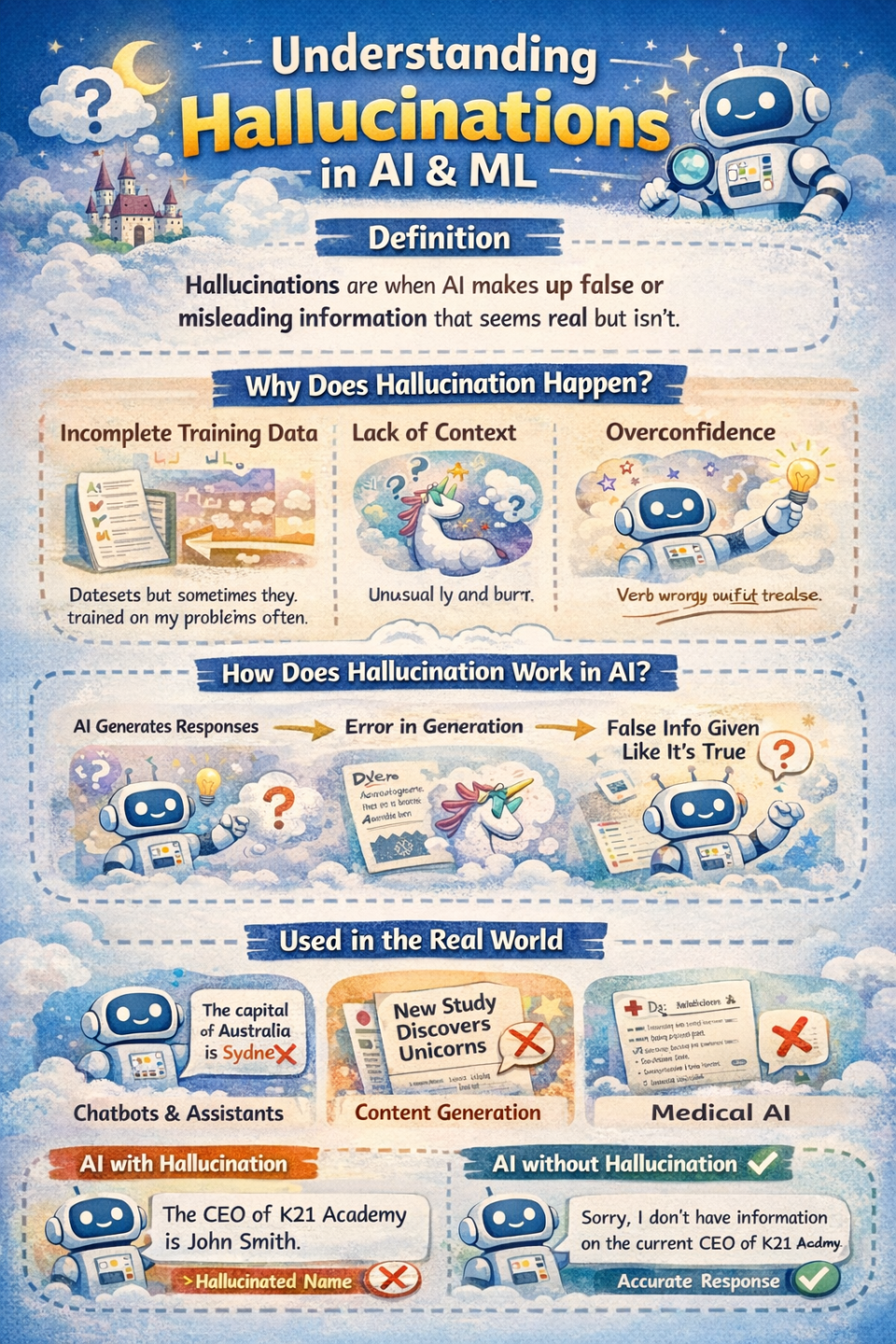
Hallucination in AI occurs when an AI model produces outputs (such as text, images, or responses) that are false, fabricated , or inaccurate , even though the model presents them confidently as true.
Why Does Hallucination Happen? ❓
Incomplete Training Data : AI models are trained on large datasets, but sometimes the data they are trained on may be incomplete or biased, leading the model to "guess" or "make up" information when it encounters gaps.
Lack of Context : If the AI doesn’t have all the details or relevant context, it might generate plausible-sounding but inaccurate information.
Overconfidence : AI models can sometimes sound convincing, even when they are wrong, because they try to predict answers based on patterns, not reality.
How Does Hallucination Work in AI? ⚙️
AI Generates Responses : AI models generate text, images, or outputs based on patterns they’ve learned from data.
Error in Generation : If the model lacks proper data, context, or has been trained on biased examples, it might create responses that seem correct but are factually incorrect.
Misleading Confidence : Even if the output is wrong, the model might sound confident about it, making it harder for users to realize the information is incorrect.
Used in the Real World 🌍
- Chatbots and Virtual Assistants : A chatbot might hallucinate when asked about specific facts, like giving incorrect details about a company or a person, making it seem like the assistant "knows" the information when it’s not accurate.
Example : A virtual assistant saying, “The capital of Australia is Sydney,” when it is actually Canberra.
- Content Generation : Generative AI can create essays, stories, or articles, but sometimes it invents facts, names, or scenarios that never existed.
Example : Generating an article that includes a non-existent study or research paper as a source.
- Medical AI : AI models used in healthcare can hallucinate diagnoses or treatment suggestions if not properly trained on reliable medical data.
Example : An AI system suggesting an incorrect drug for treatment, based on faulty or outdated data.
Visual Representation:
Hallucination in AI ➡ AI thinking it "knows" but creating incorrect information 🔮✨
Correct AI Output ➡ Based on real data and facts ✅
Example to Understand Hallucination: 💬
AI with Hallucination :
Question : "Who is the CEO of K21 Academy?"
AI's Response : "The CEO of K21 Academy is John Smith."
(Hallucinated Name) - The actual CEO is someone else.AI without Hallucination :
Question : "Who is the CEO of K21 Academy?"
AI's Response : "Sorry, I don’t have information on the current CEO of K21 Academy."
(Accurate Response)
Key Takeaways: 📝
Hallucination in AI is when it "imagines" information that is not real or not correct.
It can happen due to imperfect training , lack of data , or context.
While it can sound convincing, hallucinated data is not reliable and should be verified.
In summary, hallucination in AI can be like the AI "dreaming" up answers. It’s important to be aware of it and always check AI-generated information, especially in critical fields like healthcare, business, and legal matters.