L4: Prompting Techniques
L4: Prompting Techniques
36:57
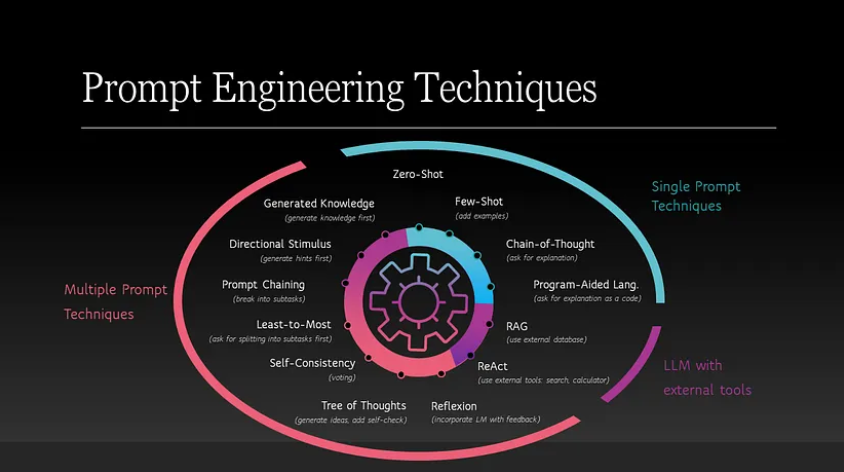
Prompting techniques are strategies used to structure input queries effectively so that an AI model generates the desired output. Here are some of the key prompting techniques used in AI and natural language processing tasks:
Hands-on Labs:
Text Generation using Prompt Engineering techniques in Azure AI Studio
Text Generation using Prompt Engineering techniques in Amazon Bedrock
Text Generation using Prompt Engineering techniques using Python
Overview & Key Concepts
1. Clear and Specific Prompts
Purpose: To minimize ambiguity and ensure the AI understands the exact task.
How It Works: The more specific and detailed the prompt, the better the model can tailor its response to your needs.
Example Prompt:
Instead of: "Write about social media marketing."
Use: "Write a 300-word article about the impact of TikTok on social media marketing strategies for small businesses in 2024."
Why It’s Effective: It reduces room for interpretation and ensures the output is focused on the desired topic and format.
2. Zero-shot Prompting
Purpose: To instruct the AI to perform a task it hasn’t been explicitly trained on, using only the prompt itself.
How It Works: The model is given a task without examples or prior context, and it has to infer the instructions based on its general knowledge.
Example Prompt:
"Translate this English sentence into French: 'The weather is nice today.'"
Why It’s Effective: You rely on the model’s general understanding and ability to make inferences about the task without having to provide examples.
3. Few-shot Prompting
Purpose: To give the model a few examples of how to perform the task so it can generalize and generate a more accurate response.
How It Works: You provide a small set of examples along with the task so that the model can learn the pattern from them.
Example Prompt:
“Translate the following sentences into French:
'Good morning!' → 'Bonjour!'
'How are you?' → 'Comment ça va?'
Now translate: 'Good evening!'”
Why It’s Effective: It allows the model to follow the structure of the examples provided, improving accuracy in task completion.
4. Chain-of-Thought Prompting
Purpose: To guide the AI through a logical step-by-step process to arrive at an answer, especially in complex reasoning tasks.
How It Works: The prompt encourages the AI to break down the task into smaller steps before providing the final answer, improving reasoning and problem-solving.
Example Prompt:
“What is the sum of 29 and 56? First, add 20 to 29, then add 50 to 56, and finally combine the results.”
Why It’s Effective: It encourages the model to follow a structured reasoning path, which can help in tasks like math problems, decision-making, and logical deductions.
5. Role-based Prompting
Purpose: To set the model in a specific role or persona to generate responses in a consistent tone or style.
How It Works: By assigning a specific role (e.g., teacher, mentor, business consultant), the model can tailor its language, structure, and knowledge accordingly.
Example Prompt:
“You are a professional financial advisor. Advise a client on how to save for retirement while minimizing risk.”
Why It’s Effective: Setting a role for the AI helps it generate responses that align with the tone and expertise expected in that specific context.
6. Instruction-based Prompting
Purpose: To provide a clear set of instructions or requirements that the AI must follow in order to generate a targeted response.
How It Works: Directly stating the rules or structure of the output helps the AI understand what kind of response you are expecting.
Example Prompt:
“Generate a list of 5 innovative marketing ideas for a new online learning platform, each with a brief description (2-3 sentences).”
Why It’s Effective: It ensures the AI knows the format and the level of detail required for the response.
7. Temperature and Top-p Sampling Control
Purpose: To control the creativity and randomness of the model's responses.
How It Works: By adjusting the temperature and top-p (nucleus sampling), you can control how deterministic or creative the AI’s output is. Higher temperature values (e.g., 1.0) lead to more creative responses, while lower values (e.g., 0.2) make responses more focused and deterministic.
Example:
Temperature = 0.2: "What is the capital of France?" → "Paris"
Temperature = 0.9: "What is the capital of France?" → "Paris, also known as the City of Lights, is not only the capital but also the largest city in France, famous for its art, culture, and history."
Why It’s Effective: You can adjust the AI’s output style based on the context or purpose of the task, whether it requires precision or creativity.
8. Contextual Prompting
Purpose: To provide enough background or context within the prompt itself to make the model’s output relevant and coherent.
How It Works: The AI needs context about the problem or conversation to generate meaningful responses, especially for more advanced tasks.
Example Prompt:
"You are working as a project manager for a software development company. A client has asked you for an update on the timeline of their mobile app project. Write an email response addressing their inquiry and provide a status update."
Why It’s Effective: Providing context about the task or situation allows the AI to generate a more tailored and appropriate response.
9. Interactive Prompting
Purpose: To have a back-and-forth dialogue with the AI to refine or evolve the output iteratively.
How It Works: The AI is prompted with a query, and the user engages in a conversation to further refine the output. This allows for more control over the response generation process.
Example Prompt:
First prompt: “Tell me about the impact of AI on healthcare.”
Follow-up: “Expand on the ethical implications of AI in healthcare, especially regarding patient privacy.”
Why It’s Effective: Interactive prompting allows for more refined, nuanced outputs, particularly useful for more complex or open-ended tasks.
10. Formatting-based Prompting
Purpose: To guide the model into generating content in a specific format, such as lists, tables, or bullet points.
How It Works: You explicitly specify the format in which the AI should present its response.
Example Prompt:
“Summarize the benefits of exercise in a table format with three columns: Benefit, Description, and Evidence.”
Why It’s Effective: It directly guides the AI to produce structured content that meets the desired formatting requirements.