Adversarial Machine Learning
Adversarial Machine Learning
What is Adversarial Machine Learning?
Definition:
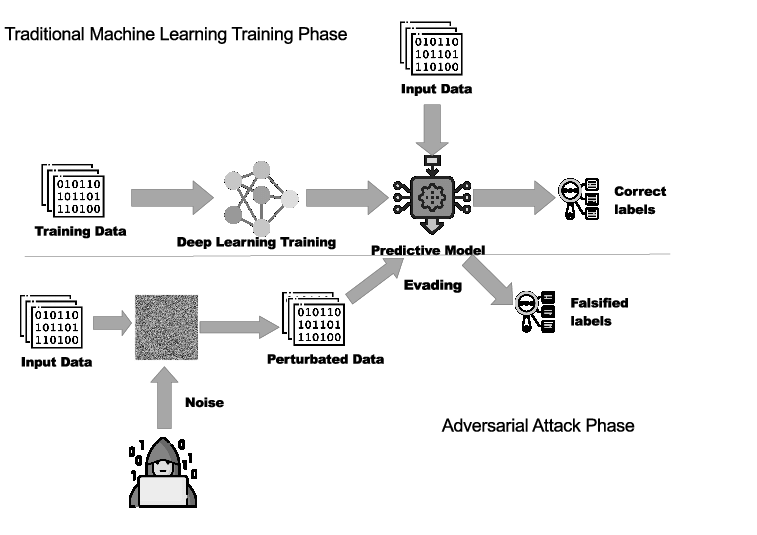
Adversarial machine learning involves techniques used to manipulate machine learning models by feeding them deliberately crafted, misleading inputs (called adversarial examples) to cause the model to make incorrect predictions or classifications.Purpose:
These techniques aim to understand and improve the robustness of machine learning models against malicious attacks or unexpected inputs. Adversarial attacks exploit the weaknesses in machine learning models that perform well on normal data but fail in certain edge cases.
Types of Adversarial Attacks
Evasion Attacks:
Goal: Attackers manipulate input data to cause a misclassification or error, often in real time.
Example: Modifying an image slightly to make it misclassified by a deep learning model (e.g., turning a cat image into one that the model classifies as a dog).
Poisoning Attacks:
Goal: Attackers inject malicious data into the training set, corrupting the learning process and causing the model to learn incorrect patterns.
Example: Inserting poisoned data points (e.g., fraudulent transactions) into a financial fraud detection system to make it less effective.
Model Inversion:
Goal: Using adversarial methods to infer private or sensitive information about the model's training data.
Example: Extracting personal data from a model trained on medical information, even when the data itself is not directly accessible.
Transfer Attacks:
Goal: Adversarial examples generated for one model can be transferred to another model with similar architecture, causing it to fail as well.
Example: An adversarial input generated to fool a model can also fool other models that weren't directly attacked.
Techniques Used in Adversarial Attacks
Fast Gradient Sign Method (FGSM):
Technique: Uses the gradients of the loss function with respect to the input data to create small perturbations in the input that cause misclassification.
Usage: Often used in image classification tasks.
Projected Gradient Descent (PGD):
Technique: An iterative version of FGSM that makes multiple small changes to the input to maximize the attack's effectiveness.
Usage: More robust than FGSM and widely used for more advanced attacks.
Carlini & Wagner Attack:
Technique: A highly effective attack that creates adversarial examples while minimizing the perceptibility of the changes made to the input data.
Usage: Commonly used against image classification and reinforcement learning systems.
DeepFool:
Technique: Iteratively adjusts the input to get as close as possible to the decision boundary of the model.
Usage: Known for being one of the most efficient attacks.
Challenges in Adversarial Machine Learning
Robustness of Models:
- Many models, especially deep learning-based ones, are highly susceptible to adversarial attacks. Despite achieving high accuracy on clean datasets, they can perform poorly on slightly altered inputs.
Detection of Adversarial Examples:
- Detecting and defending against adversarial attacks is a significant challenge. It requires the model to identify and reject malicious inputs while still maintaining performance on normal data.
Adversarial Training:
- Concept: One solution is adversarial training , where the model is trained using adversarial examples along with regular data to improve its robustness. However, adversarial training can be computationally expensive and may not always be effective against all types of attacks.
Lack of Standards:
- The field of adversarial machine learning is still developing, and there is no universal standard for evaluating the effectiveness of defenses against adversarial attacks.
Defensive Techniques Against Adversarial Attacks
Adversarial Training:
- Involves augmenting the training set with adversarial examples so the model learns to recognize and correctly classify them.
Input Preprocessing:
- Denoising techniques such as JPEG compression or feature squeezing can be used to reduce the effectiveness of adversarial perturbations by removing noise or unnecessary features in the input.
Gradient Masking:
- Attempts to hide the gradient information that attackers need to generate adversarial examples. However, gradient masking is not always a robust defense and can be bypassed.
Certified Defenses:
- Some techniques provide a guarantee that the model is robust to a particular class of adversarial attacks. Provable defenses aim to mathematically verify the model's resistance to adversarial perturbations.
Model Ensembling:
- Using an ensemble of models for decision-making can reduce the impact of adversarial attacks, as attackers are less likely to fool all models in the ensemble.
Real-World Impact of Adversarial Attacks
Autonomous Vehicles:
- Adversarial attacks can be used to trick self-driving cars into misidentifying road signs or pedestrians, posing a safety risk.
Facial Recognition Systems:
- Adversarial attacks can be used to spoof facial recognition systems, allowing unauthorized access to secure systems or areas.
Cybersecurity:
- Adversarial examples can be used to evade detection by spam filters, firewalls, and intrusion detection systems, compromising security.
Medical Systems:
- Adversarial attacks on medical diagnostic models can cause misdiagnoses, leading to incorrect treatment decisions and potentially jeopardizing patient health.
Key Takeaways
Adversarial Machine Learning highlights the vulnerabilities in machine learning models, especially in real-world applications where attacks can cause significant harm.
Ongoing research focuses on improving model robustness, detection techniques, and developing effective defenses.
Ethical Considerations: Adversarial attacks raise concerns about the security, fairness, and accountability of machine learning systems in critical sectors.