Sampling
Sampling
What is Sampling in AI, ML, and Gen AI? 🤖📊
In Artificial Intelligence (AI) , Machine Learning (ML) , and Generative AI (Gen AI) , sampling is a technique used to select a subset of data from a larger dataset or a pool of possibilities. This subset, or "sample," is used to make decisions, predictions, or generate responses, making it easier for AI models to handle large amounts of information.
Definition :
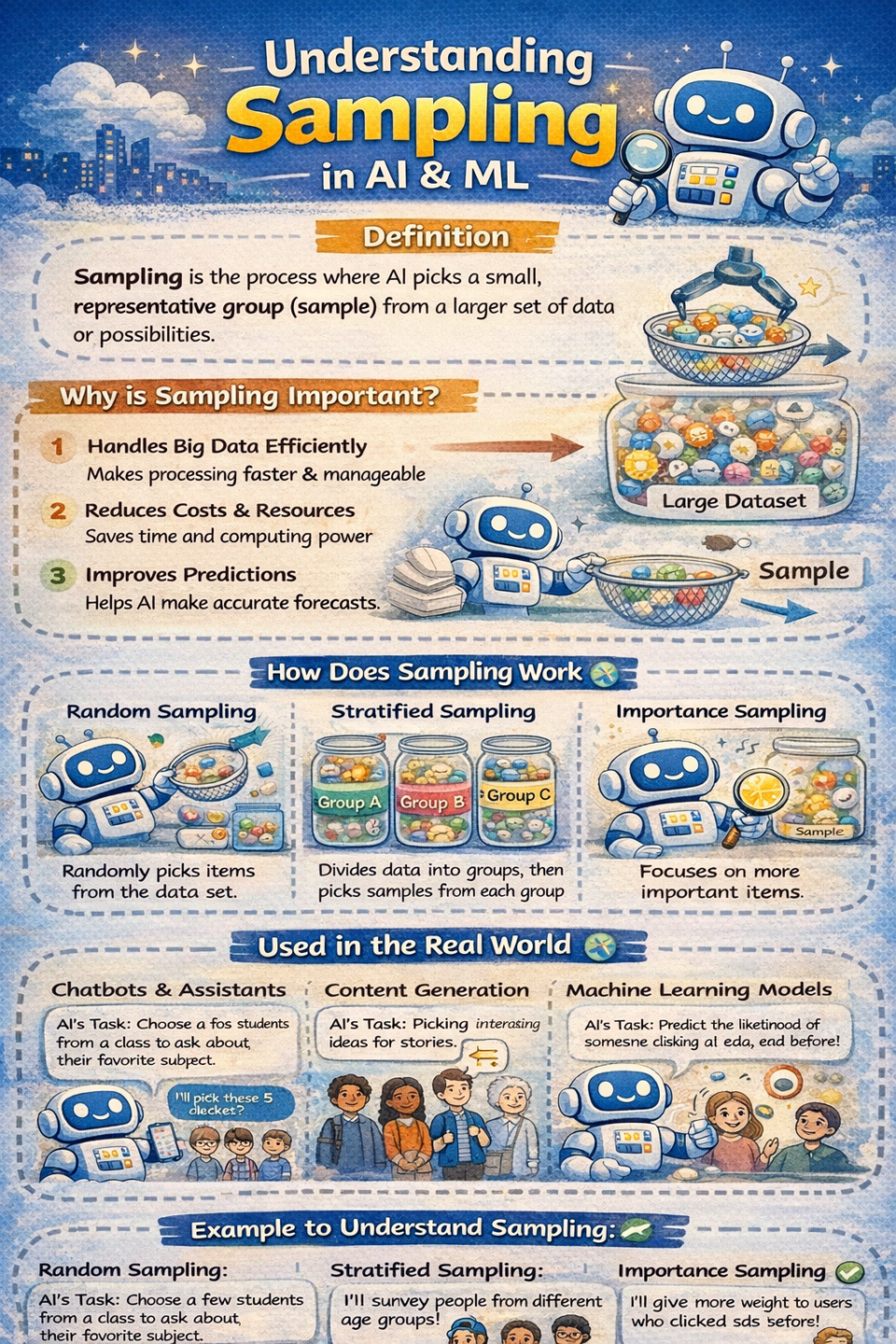
Sampling refers to the process of selecting a small portion (sample) from a larger set of data to make predictions, draw conclusions, or create something new. In AI, this could be selecting a small subset of data from a larger dataset, or choosing specific possible outcomes (like words or actions) based on probability.
Why is Sampling Important? 🤔
Efficient Handling of Large Data : AI models often deal with huge datasets, so sampling helps the AI focus on a smaller, manageable portion of the data while still making accurate predictions.
Reduces Computational Cost : By using samples, AI can process data faster, saving computational resources like memory and processing power.
Improves Generalization : Sampling helps AI models to make good predictions even with limited data, ensuring they don't overfit to specific examples but can generalize to new, unseen data.
How Does Sampling Work? ⚙️
Random Sampling : This is the most common method, where data points are selected randomly from the entire dataset. This helps the AI to see a variety of possibilities and learn patterns.
Stratified Sampling : Sometimes, data is divided into different groups or "strata," and a sample is taken from each group. This method ensures the sample represents all parts of the data.
Importance Sampling : This method gives more weight to some data points that are more important or have higher probability. It helps in situations where certain pieces of data are more relevant than others.
Used in the Real World 🌍
- Chatbots and Virtual Assistants : Sampling is used to pick the most relevant responses from a large set of possible answers. This makes sure the assistant gives the most appropriate response based on the user's question.
Example : If you ask a chatbot for a restaurant suggestion, it will sample from the list of restaurants based on your location and preferences, providing a list of relevant suggestions.
- Content Generation : In AI content creation, sampling helps the model select which words, sentences, or ideas to use from a large pool, making sure the generated content is coherent and interesting.
Example : When generating a story or poem, sampling helps pick the right words and ideas to keep the narrative flowing.
- Machine Learning Models : In training, sampling is used to create mini-batches of data that the model processes at once. This helps the model learn faster without needing to process the entire dataset every time.
Example : In an image recognition task, the AI model might sample a small group of images from a massive dataset to train on and learn how to recognize specific objects.
Visual Representation :
Sampling Process ➡ Selects a small portion of data from a larger set 📉
Random Sampling ➡ Picks items randomly from the set 🎲
Stratified Sampling ➡ Ensures all groups are represented 🏆
Importance Sampling ➡ Focuses on more important data points 🔍
Example to Understand Sampling : 💬
Random Sampling :
AI’s Task : Choose a few students from a class to ask about their favorite subject.
AI’s Response : Randomly picking 5 students and asking them.Stratified Sampling :
AI’s Task : Pick a group of people to survey about food preferences.
AI’s Response : Making sure that people from different age groups (teenagers, adults, seniors) are all included in the survey.Importance Sampling :
AI’s Task : Predict the likelihood of someone clicking an ad.
AI’s Response : Giving more weight to users who have previously clicked ads, as they are more likely to click again.
Key Takeaways: 📝
Sampling is about selecting a small, manageable subset of data from a larger set to make predictions or decisions.
It’s used to save time, resources , and ensure accuracy while avoiding overwhelming the AI with too much information.
It’s used in chatbots, content generation , and machine learning to improve performance and efficiency.
In summary, sampling helps AI work smarter by using just the right amount of data, making it possible to generate accurate, fast , and relevant responses without needing to process everything!