Vector Databases (FAISS) & Embeddings
Vector Databases (FAISS) & Embeddings
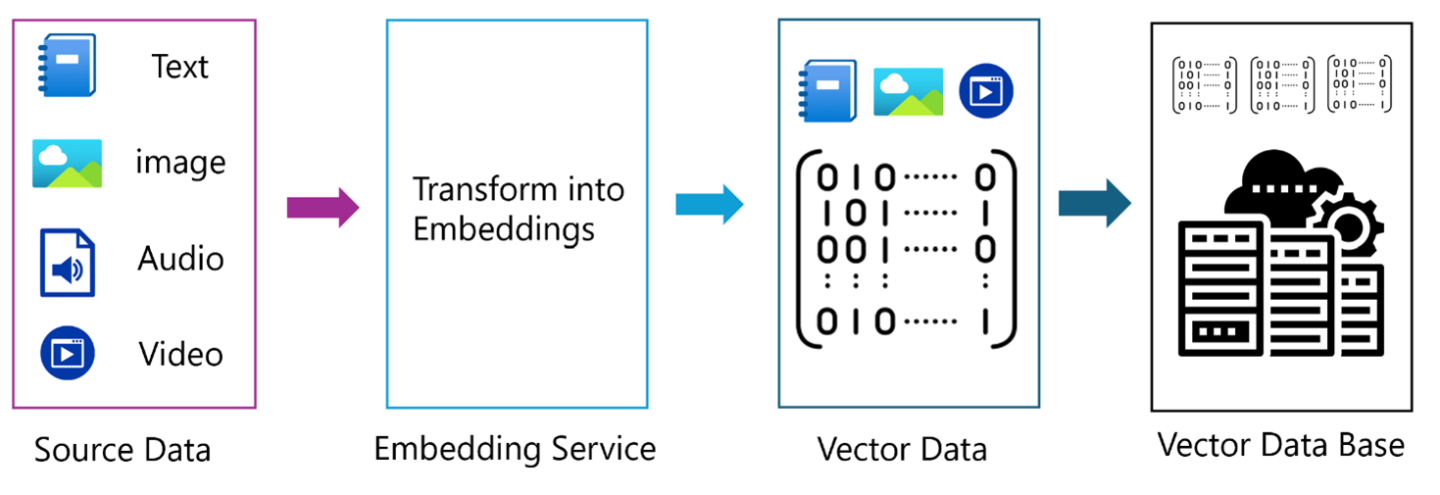
Vector Database
- A vector database is a type of database that is specifically designed to store and manage vectors. Vectors in this context are mathematical representations of data, often used in machine learning and AI models. These vectors can represent various forms of data, such as text, images, audio, or even videos, in a high-dimensional space.
In simple terms, a vector database enables efficient nearest neighbor search (NNS) and similarity search. It's optimized to find and retrieve items that are similar to a given query vector. For example:
1. **Text Search** : In natural language processing (NLP), vector databases can be used to store word or sentence embeddings (vectors) and quickly find the most similar words or sentences based on cosine similarity or Euclidean distance.

2. **Image Search** : For image-based applications, vectors can represent features of images (e.g., using a deep learning model) and help find similar images to a given query.

3. **Recommendation Systems** : Vector databases are commonly used in recommendation engines, where they store user profiles or product embeddings and efficiently find similar products to recommend.
Key features of vector databases:
* **High-Dimensional Indexing** : Vectors are often high-dimensional (hundreds or thousands of dimensions), and vector databases use specialized indexing methods like **FAISS (Facebook AI Similarity Search)** or **HNSW (Hierarchical Navigable Small World)** for efficient retrieval.

* **Fast Search** : Vector databases are optimized for fast searching of large volumes of data by similarity (e.g., finding items closest to a given vector).

* **Scalability** : These databases can handle millions or even billions of vectors, allowing them to scale with large datasets.
Popular Vector Databases:
* **FAISS** : An open-source library from Facebook AI designed for efficient similarity search and clustering of dense vectors.

* **Milvus** : An open-source vector database optimized for machine learning and AI applications, with support for multi-modal search.

* **Pinecone** : A managed vector database service that provides efficient similarity search in real-time.

* **Weaviate** : An open-source vector database that supports AI-powered search and integrates with machine learning pipelines.
In summary, a vector database allows you to store, retrieve, and search high-dimensional data in a way that’s efficient for AI/ML applications, especially for tasks like similarity search, recommendation, and information retrieval.
Embeddings
- Embeddings are a way to convert things like words, sentences, or even images into numbers (specifically vectors, which are lists of numbers). These numbers help computers understand the meaning or characteristics of those things.
Imagine you have a word like "dog." In its embedding , "dog" could be represented by a list of numbers like:
[0.3,0.5,−0.1,0.8][0.3, 0.5, -0.1, 0.8]
These numbers don't mean much by themselves, but when you compare "dog" with another word like "cat," their numbers will be close to each other, showing that "dog" and "cat" are similar in meaning (both animals).
Why Use Embeddings?
* **Human Words → Machine Understanding** : Computers don't understand words the way we do. Instead of "dog" meaning "a furry animal," the computer sees it as a set of numbers. By using embeddings, we make it easier for computers to understand the meaning of words, sentences, or even images.

* **Find Similar Things** : Embeddings help the computer find similar things. For example, it can find that "cat" is similar to "dog" and "car" is different from both.
How Do Embeddings Work?
1. **Training** : To create embeddings, we teach the computer by showing it lots of examples. For example, we show it many sentences or pictures, and it learns how to convert these into vectors (lists of numbers).

2. **Relationships in Numbers** : When the computer finishes learning, words or items with similar meanings will have **similar** embeddings (numbers close to each other), and those with different meanings will have **different** embeddings (numbers far apart).
Real-Life Example:
Let's say you're using a search engine and you type the word "dog." The search engine uses embeddings to find other words or pages that are similar to "dog," such as "puppy" or "pet," because their embeddings (number representations) are close to "dog" in the computer’s vector space.
Where Are Embeddings Used?
* **Word Embeddings** : In language, embeddings help with tasks like searching for similar words or translating between languages.

* **Image Embeddings** : In pictures, embeddings help find similar images. For example, you can search for "cat" and the system will find similar images of cats.

* **Recommendation Systems** : Embeddings help recommend things, like suggesting movies or songs based on what you liked before.
Summary in Simple Terms:
* Embeddings are just **lists of numbers** that represent things like words or images.

* They help computers understand the **meaning** of things by making similar things close to each other in a list of numbers.

* For example, "dog" and "cat" would be closer in their number representation than "dog" and "car."

* They are used in things like search engines, recommendation systems, and even in understanding pictures.
So, embeddings are like a translator that turns things we understand into numbers that computers can work with!
Vector
- A vector is a mathematical concept that represents both magnitude (size) and direction. In simple terms, a vector is like an arrow pointing from one place to another, with both a length and a direction.
Here's a simple breakdown:
1. **Magnitude** : The length of the vector (how big or small it is).

2. **Direction** : The way the vector points (the angle or orientation).
Everyday Examples:
* **Walking in a straight line** : Imagine you're walking in a straight line. If you walk 5 steps north, your movement can be represented as a vector. The **magnitude** would be the number of steps (5 steps), and the **direction** would be **north**.

* **Driving** : If you're driving, the car moves in a certain direction (east, west, etc.) and at a certain speed. Your movement can also be described by a vector, where the speed is the **magnitude** and the direction of travel (east, for example) is the **direction**.
In 2D or 3D Space:
Vectors can also represent movements or positions on a map (2D) or in 3D space. For example:
* In **2D** , a vector could be represented by two numbers (like [3,4][3, 4]), where:

  * The first number (3) shows movement along the horizontal axis (left to right).

  * The second number (4) shows movement along the vertical axis (up and down).

* In **3D** , a vector could have three numbers (like [3,4,5][3, 4, 5]), where:

  * The first number (3) shows movement along the **x-axis** (left to right).

  * The second number (4) shows movement along the **y-axis** (up and down).

  * The third number (5) shows movement along the **z-axis** (forward or backward).
In Simple Words:
A vector is just a way to describe movement :
* How far something moves (the length or magnitude).

* In which direction it moves (the direction).
Why Are Vectors Important?
* **In Computer Science & AI**: Vectors are used to represent data like words or images. They help machines understand and compare things.References/Related
- Understading Vector Databases from Microsoft >> https://learn.microsoft.com/en-us/data-engineering/playbook/solutions/vector-database/