L4: AI Agentic Architecture
L4: AI Agentic Architecture
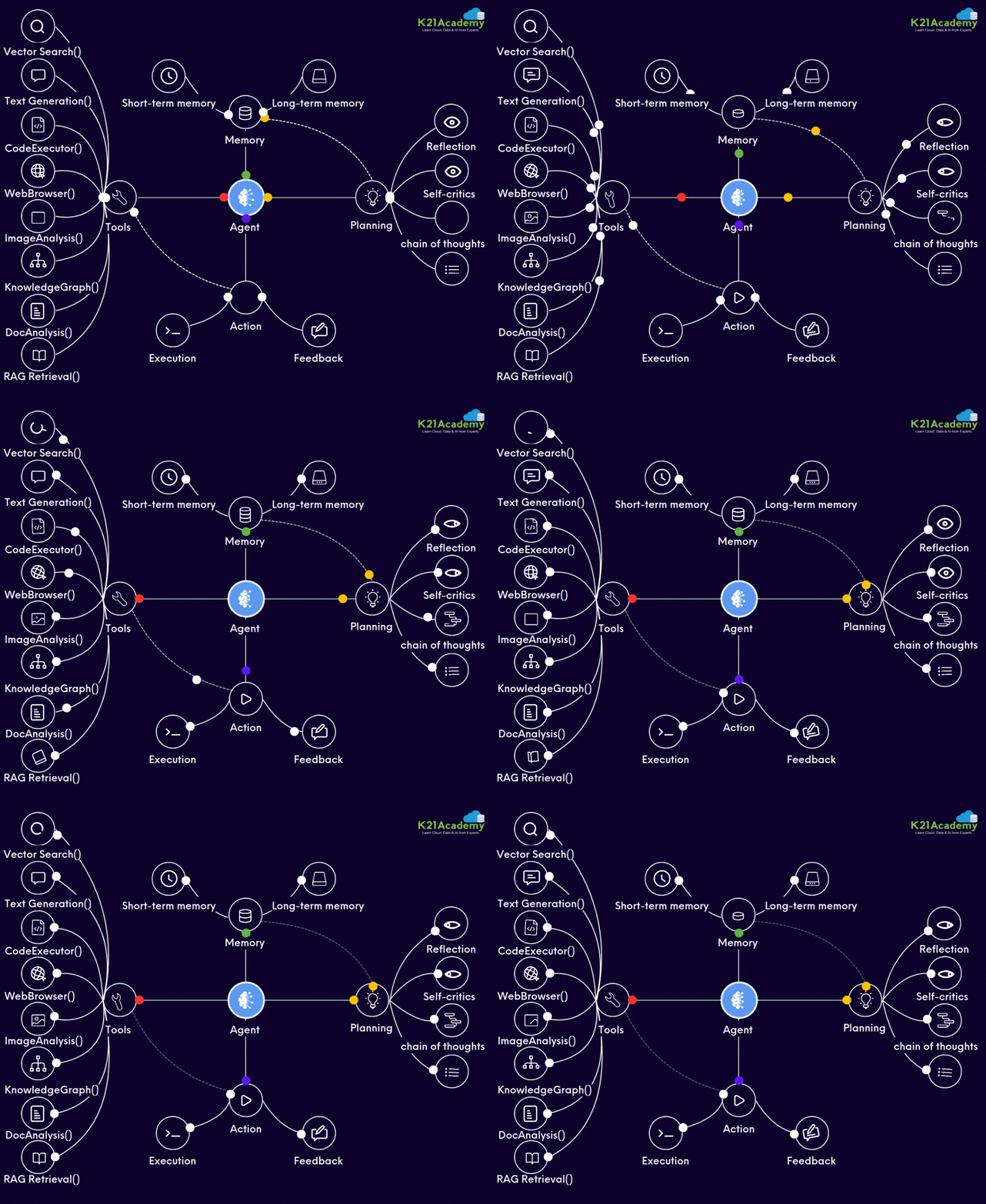
AI Agentic Architecture refers to the underlying framework and structure that governs the interactions, behaviors, and decision-making of AI agents within a system or environment.
It defines how multiple agents (or a single agent) operate, collaborate, and perform tasks autonomously, often within a larger ecosystem of interconnected systems.
This architecture is used to design, model, and implement intelligent systems where agents can make decisions, learn, and execute actions based on their environment.
Key Components of AI Agentic Architecture:
Agents :
The core building blocks of agentic architecture are AI agents themselves. Each agent is designed to perform specific tasks, make decisions, and interact with the environment.
These agents can be autonomous, semi-autonomous, or reactive, and they may communicate with other agents or external systems.
Environment :
The environment is the context or the "world" in which agents operate. It can include real-world data, virtual environments, or systems that the agents can perceive and interact with.
The environment provides inputs (e.g., data, sensory information) that the agents use to make decisions and take actions.
It can be dynamic (constantly changing) or static (more stable over time), and agents react to changes in the environment.
Sensors and Perception :
Sensors are used by agents to gather data from the environment. These can include cameras, microphones, GPS, or other sensors, depending on the type of agent.
Perception refers to how agents process and interpret sensory inputs. For example, an AI agent might use computer vision to analyze images or natural language processing to understand text.
Decision-Making/Reasoning :
This is the core cognitive process of the agent. AI agents use various techniques like machine learning , rule-based systems , or planning algorithms to make decisions.
Agents may also use heuristics or reinforcement learning to choose the most appropriate action based on their goals and the state of the environment.
Actuators/Actions :
Actuators are the components that allow agents to take action in the environment. For instance, a robot might move using actuators like motors, while a virtual assistant might respond to a query by generating text or voice output.
The architecture ensures that agents can perform actions based on their decisions, which may involve manipulating the environment or interacting with other agents.
Learning and Adaptation :
Many AI agents are learning agents , meaning they can adapt to new information and improve their performance over time.
They can use techniques like reinforcement learning , where agents receive feedback (rewards or penalties) for their actions and adjust their behavior accordingly.
Communication :
In multi-agent systems, communication between agents is crucial for coordination and collaboration. Agents may exchange messages or data to share information and align their actions.
Communication protocols are used to ensure that the agents’ actions align with the overall goal of the system.
Goals and Objectives :
Each agent has one or more goals that it tries to achieve. These goals can be predefined (e.g., a robot navigating a room) or dynamically generated (e.g., an AI in a game trying to win).
The architecture defines how agents pursue their goals, either individually or collaboratively with other agents.
Types of AI Agentic Architecture:
Centralized vs. Decentralized Architectures :
Centralized architecture : A single central system manages and controls the behavior of all agents. The central system might dictate what each agent should do and when.
Decentralized architecture : Each agent is independent and can make decisions autonomously, with minimal or no coordination with other agents. This is often used in multi-agent systems (MAS).
Reactive vs. Deliberative Architectures :
Reactive agents : These agents operate by responding directly to stimuli from their environment. They do not retain memory or plan ahead and typically follow predefined rules or behaviors.
Deliberative agents : These agents plan their actions based on an internal model of the world and may reason through multiple steps ahead. They can store past information, use it for future decisions, and can plan complex actions.
Hierarchical Agent Architectures :
This architecture organizes agents into different levels or layers. The high-level agents manage long-term strategic goals, while low-level agents handle day-to-day operations and immediate actions.
Common in robotics, where a high-level agent makes overall decisions, and low-level agents handle basic motor control.
Multi-Agent Systems (MAS) :
MAS involves multiple agents that work together to achieve a common goal, solve problems, or simulate environments.
These systems use coordination , negotiation , and collaboration among agents to perform complex tasks, such as autonomous driving fleets or AI in multiplayer games.
Designing AI Agentic Architecture:
Scalability :
- The architecture should be scalable to handle a growing number of agents or more complex tasks. For example, in large-scale industrial robots, the system architecture should allow for the seamless addition of new agents without performance degradation.
Flexibility :
- AI agent architectures need to be adaptable to different environments and tasks. The architecture must allow agents to change behavior as new goals or information are introduced.
Modularity :
- A modular architecture allows for the development and testing of individual agent components (e.g., perception, decision-making, action) in isolation, which simplifies maintenance and future upgrades.
Fault Tolerance :
- The architecture should handle errors and failures gracefully, ensuring that the failure of one agent doesn’t bring down the entire system. This is crucial in safety-critical applications like autonomous vehicles or healthcare robots.
Collaboration and Coordination :
- In systems with multiple agents, coordination is vital. The architecture must allow agents to communicate and work together toward a common goal, ensuring that actions don’t conflict and resources are efficiently used.
Examples of AI Agentic Architecture:
Autonomous Vehicles : In autonomous vehicles, AI agents (e.g., navigation agents, object detection agents, decision-making agents) work together to drive the vehicle safely. They operate based on real-time data from sensors and must coordinate to navigate the environment.
Multi-Agent Systems (MAS) in Gaming : AI agents in video games might include characters controlled by different agents that interact with the player, respond to actions, and pursue individual goals within a shared environment. These agents follow complex hierarchical and reactive architectures.
Smart Home Systems : A smart home can have various AI agents for lighting, security, temperature control, and entertainment. These agents communicate with each other and learn the preferences of users to optimize the environment automatically.
Industrial Robotics : In a manufacturing setting, multiple robots work autonomously and cooperatively to assemble products. Each robot is an agent, and the architecture coordinates their actions to ensure smooth workflow, avoiding collisions or redundancies.
Benefits of AI Agentic Architecture:
Autonomy : AI agents can perform tasks with minimal human intervention.
Scalability : Systems can easily scale by adding new agents to perform new tasks or enhance existing operations.
Efficiency : Agents can be highly optimized for specific tasks, improving system performance.
Adaptability : AI agents can adapt to new situations, learning and evolving over time based on data.
Challenges of AI Agentic Architecture:
Coordination Complexity : Ensuring that multiple agents work together harmoniously can be complex, especially in dynamic environments.
Resource Management : Efficiently managing resources (e.g., computing power, data) across agents can be challenging.
Ethical Concerns : Autonomous agents that make decisions on their own can lead to ethical dilemmas, particularly in areas like surveillance, warfare, or healthcare.
Conclusion:
AI Agentic Architecture provides a structured framework for building intelligent systems that can autonomously perceive, decide, and act.
It is crucial in scenarios that require complex decision-making, collaboration, and adaptability, like autonomous vehicles, multi-agent systems, robotics, and virtual assistants.
By understanding and designing agentic architectures, we can create more sophisticated and efficient AI systems capable of performing tasks autonomously in dynamic and diverse environments.