L1: Introduction to Machine Learning (ML)
L1: Introduction to Machine Learning (ML)
12:55
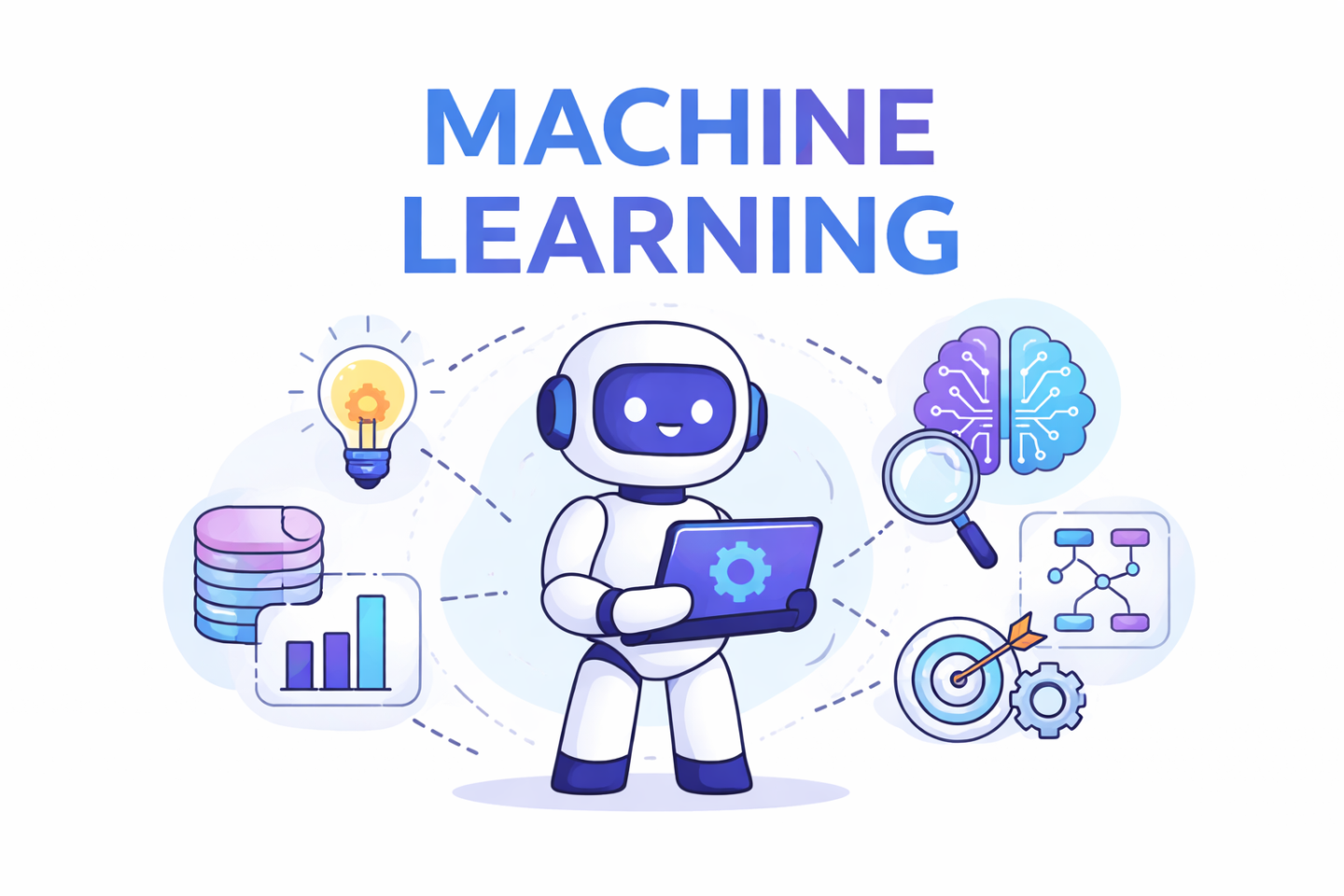
What is Machine Learning?
Machine Learning (ML) is a part of Artificial Intelligence (AI) that allows computers to learn from data instead of being programmed with fixed rules.
👉 In simple words:
Machine Learning teaches machines to learn from experience, just like humans do.
Instead of telling the computer:
“If this happens, do that”
We show the computer examples , and it figures out the pattern by itself.
Why Do We Need Machine Learning?
Traditional programs work well only when rules are very clear and fixed.
But real life is messy, complex, and always changing.
Machine Learning helps when:
Rules are too complex to write
Data is very large
Patterns are hidden
Decisions must improve over time
Examples:
Spam detection (emails change every day)
Face recognition (faces look different in lighting, angle, age)
Recommendations (everyone’s taste is different)
Simple Example of Machine Learning
Without Machine Learning (Traditional Programming)
To detect spam email, you might write rules like:
If email contains “free money” → spam
If email contains “win prize” → spam
❌ Problem: Spammers change words, rules fail.
With Machine Learning
Give the computer:
Thousands of spam emails
Thousands of non-spam emails
The ML model learns:
Common patterns
Word combinations
Sender behavior
For a new email:
- The model predicts Spam or Not Spam
✅ No fixed rules needed
✅ Model improves with more data
How Does Machine Learning Work? (Simple Flow)
Data Collection
Gather data (text, numbers, images, logs, etc.)Training
The ML algorithm studies the data and learns patternsModel Creation
The result of training is called a modelPrediction
The model is used to make predictions on new dataImprovement
More data → better learning → better predictions
What is an ML Model?
An ML model is like a trained brain for a computer.
It stores what the machine has learned
It uses math and statistics internally
You don’t need to understand the math to use it
Example:
A trained model can predict house prices
A trained model can recognize handwritten digits
A trained model can recommend movies
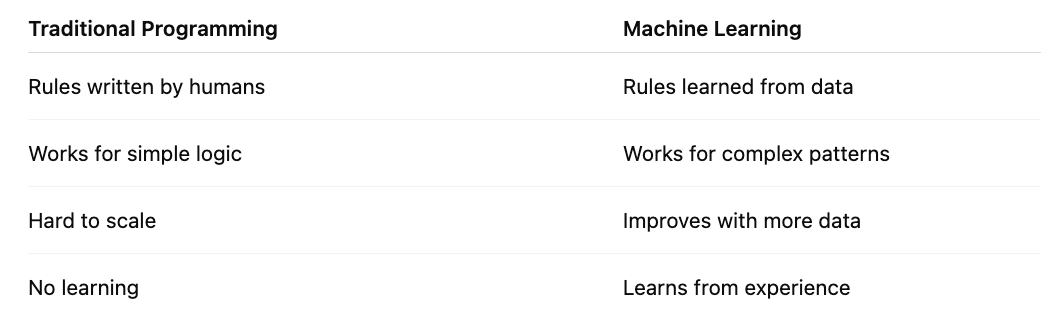
Machine Learning vs Traditional Programming
Where Is Machine Learning Used in Real Life?
Everyday Applications
Google search ranking
Netflix & YouTube recommendations
Voice assistants (Alexa, Siri)
Face unlock on phones
Business Applications
Fraud detection in banking
Customer behavior analysis
Sales forecasting
Chatbots and support systems
Advanced Applications
Self-driving cars
Medical diagnosis
Image & speech recognition
Cybersecurity threat detection
Key Terms You Should Know (Beginner Level)
Data - Information used to train ML models
Algorithm - The method used to learn patterns
Model - The trained output of an algorithm
Training - Teaching the model using data
Prediction - Output given by the model on new data
Important Point to Remember
📌 Machine Learning does NOT think like humans.
It only:
Learns patterns
Uses probabilities
Makes predictions based on data
Good data → Good ML
Bad data → Bad ML
What’s Coming Next in This Module?
In the next lessons, you will learn:
Types of Machine Learning
Supervised Learning
Unsupervised Learning
Reinforcement Learning
Real examples for each type
Simple use cases without heavy math
✅ Lesson Summary
Machine Learning helps machines learn from data
No fixed rules, learning improves over time
Used everywhere in modern technology
Foundation for Deep Learning, GenAI, and Agentic AI