L2: Types of Machine Learning
L2: Types of Machine Learning
7:13
Machine learning (ML) methods refer to a range of approaches and techniques used for training algorithms to learn patterns from data and make predictions or decisions without being explicitly programmed.
These methods can be categorized based on how the models learn and the nature of the data they process.
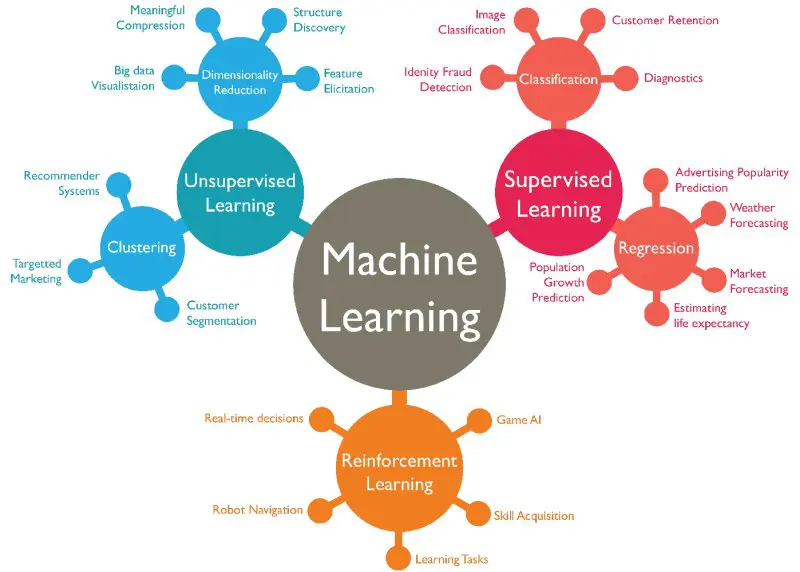
Here’s an overview of the primary types of machine learning methods:
1. Supervised Learning :
- Definition : Models learn from labeled training data, where each input has a corresponding output.
- Objective : Learn the mapping between inputs and outputs to make predictions for new data.
- Key Techniques :
- Regression : Predicts continuous values (e.g., Linear Regression, Decision Tree Regressor).
- Classification : Predicts categorical values (e.g., Logistic Regression, Support Vector Machines (SVM), K-Nearest Neighbors (KNN)).
- Ensemble Methods (e.g., Random Forest, Gradient Boosting, XGBoost).
2. Unsupervised Learning :
- Definition : Models learn from unlabeled data, finding hidden patterns or intrinsic structures.
- Objective : Discover the underlying structure or distribution in the data.
- Key Techniques :
- Clustering : Grouping data into clusters based on similarity (e.g., K-Means, DBSCAN, Hierarchical Clustering).
- Dimensionality Reduction : Reducing the number of features while preserving variance (e.g., Principal Component Analysis (PCA), t-SNE, UMAP).
- Anomaly Detection : Identifying outliers or anomalies in data (e.g., Isolation Forest, One-Class SVM).
3. Semi-Supervised Learning :
- Definition : Uses a small amount of labeled data with a large amount of unlabeled data.
- Objective : Improve the learning process by combining labeled and unlabeled data.
- Applications : Useful when labeling data is expensive or time-consuming (e.g., speech recognition, image classification).
4. Reinforcement Learning (RL) :
- Definition : Models learn by interacting with an environment, making decisions to maximize some notion of cumulative reward.
- Objective : Find a policy that maps states to actions to maximize rewards.
- Key Techniques :
- Q-Learning : Learning the value of actions in particular states.
- Deep Q-Networks (DQN) : Using deep learning to approximate Q-values.
- Policy Gradient Methods : Learning policies directly (e.g., PPO, REINFORCE).
5. Neural Networks and Deep Learning :
- Definition : Models inspired by the structure of the brain, used for complex pattern recognition.
- Objective : Learn from vast amounts of data using layered architectures.
- Key Techniques :
- Artificial Neural Networks (ANNs) : Basic neural networks.
- Convolutional Neural Networks (CNNs) : For image data.
- Recurrent Neural Networks (RNNs) : For sequential data like time series and natural language (e.g., LSTM, GRU).
- Transformer Models : State-of-the-art for natural language processing (e.g., BERT, GPT).
6. Transfer Learning :
- Definition : Uses a pre-trained model on a new, related problem.
- Objective : Leverage knowledge from a previously learned task to improve performance on a new task.
- Applications : Commonly used in computer vision (e.g., using pre-trained models like ResNet) and natural language processing (e.g., fine-tuning BERT).
7. Self-Supervised Learning :
- Definition : A form of unsupervised learning where the model generates its own labels from the data.
- Objective : Learn representations without explicit human-provided labels.
- Applications : Used in large-scale language models (e.g., GPT), image representation learning.
8. Meta-Learning (Learning to Learn):
- Definition : Aims to improve learning algorithms themselves.
- Objective : Make models that can learn new tasks faster or more effectively with fewer examples.
- Examples : Model-Agnostic Meta-Learning (MAML).
9. Anomaly Detection :
- Definition : Identifies unusual patterns that do not conform to expected behavior.
- Objective : Detect rare events or outliers.
- Key Techniques :
- Statistical Methods (e.g., Z-score, Gaussian Mixture Models)
- Isolation Forest
- Autoencoders for Anomaly Detection in deep learning.
10. Graph-Based Learning :
- Definition : Uses graph structures to represent and analyze relationships between entities.
- Objective : Learn from data that can be structured as a graph (nodes and edges).
- Key Techniques :
- Graph Neural Networks (GNNs) : For predicting node properties, edge properties, or the entire graph structure.
- Graph Convolutional Networks (GCNs).
11. Active Learning :
- Definition : The model can query the user for labels on specific data points.
- Objective : Improve learning efficiency by focusing labeling efforts on the most informative examples.
- Applications : Useful in scenarios where labeling is costly but necessary for high accuracy.
12. Bayesian Learning :
- Definition : Uses Bayes' theorem to update the probability estimate for a hypothesis as more evidence or data becomes available.
- Objective : Learn distributions and uncertainties rather than fixed point estimates.
- Key Techniques :
- Bayesian Networks
- Gaussian Processes
These methods cater to a range of scenarios, allowing practitioners to choose the approach that best matches their data type, problem nature, and resource availability.