L5: Types of AI Agent
L5: Types of AI Agent
18:08
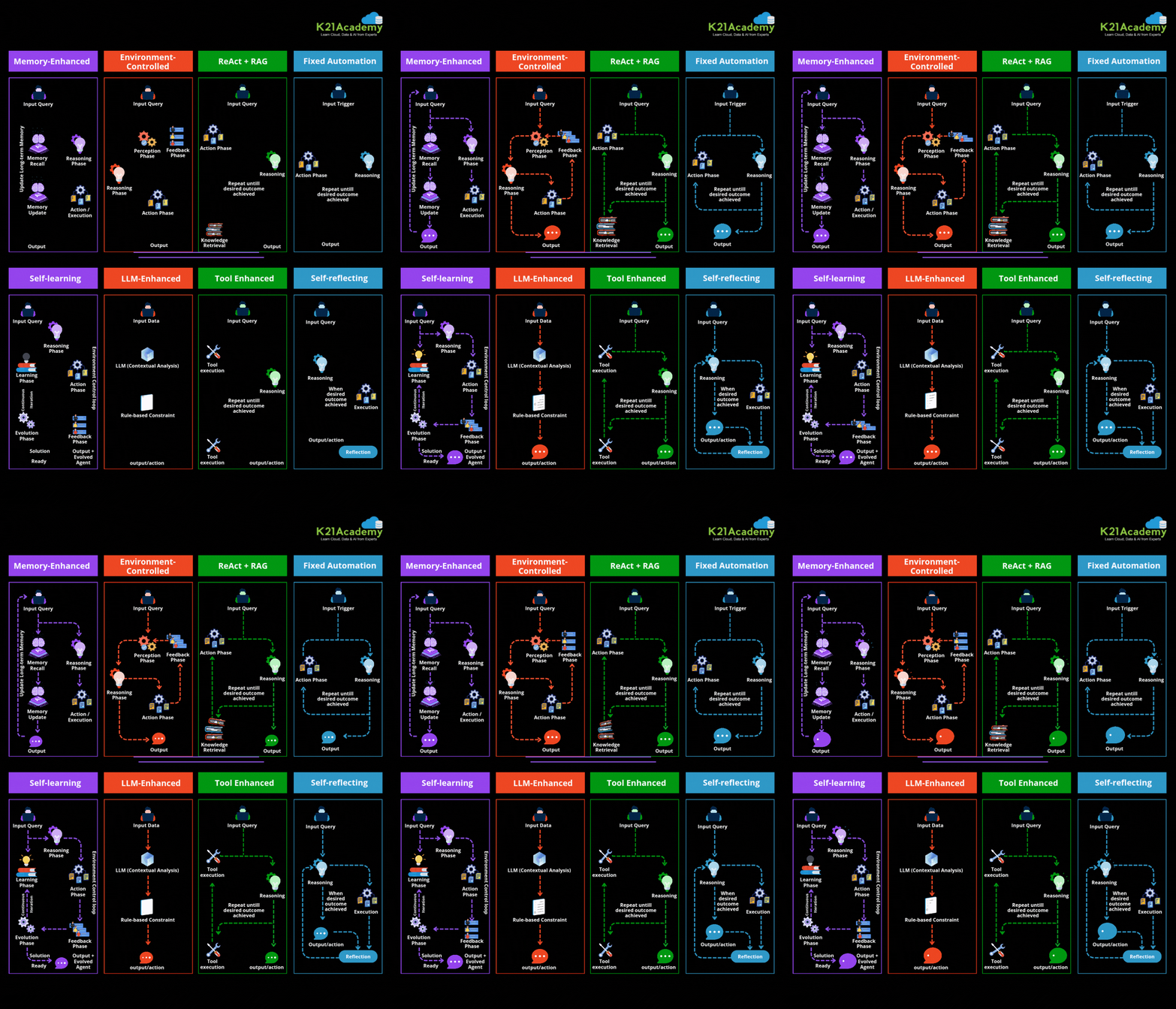
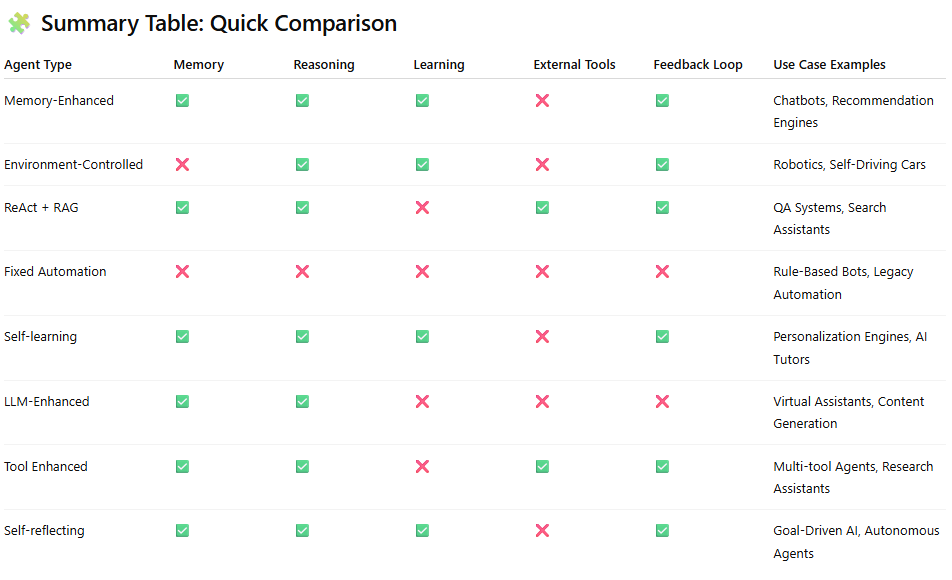
As artificial intelligence continues to evolve, the types of AI agents we deploy are becoming more sophisticated, adaptive, and specialized. Each AI agent type plays a critical role in how machines perceive, reason, learn, and act within environments, real or simulated.
Let’s explore the 8 Types of AI Agents and how each functions within the AI ecosystem:
1. Memory-Enhanced Agents
Memory-enhanced agents are designed to retain and recall past experiences , making them more adaptive and responsive over time.
Key Phases:
Input Query → Memory Recall → Reasoning Phase
Action Execution → Memory Update → Output
Use Case: Useful in conversational AI, recommendation systems, and autonomous robotics, where continuity of interaction matters.
Core Strength: These agents improve by learning from historical data and interactions , enabling more context-aware decision-making.
2. Environment-Controlled Agents
These agents dynamically respond to external stimuli from their environment. They continuously sense, reason, and act based on real-time feedback.
Key Phases:
- Input Query → Perception → Reasoning → Action → Feedback Loop
Use Case: Ideal for robotics, industrial automation, and self-driving systems where constant environmental monitoring is essential.
Core Strength: Designed for situational awareness and adaptive behavior in unpredictable environments.
3. ReAct + RAG Agents (Reasoning + Retrieval-Augmented Generation)
These agents blend reasoning and retrieval by incorporating external knowledge bases into the decision-making process.
Key Phases:
Input Query → Action Phase → Knowledge Retrieval → Reasoning
Repeat until the desired outcome is reached.
Use Case: Effective in complex question-answering systems, enterprise search, and advanced chatbots.
Core Strength: The combination of thinking and retrieving ensures more accurate and grounded outputs.
4. Fixed Automation Agents
Fixed automation agents follow pre-programmed actions based on triggers with minimal reasoning or learning.
Key Phases:
Input Trigger → Action → Output
May include simple feedback, but with no learning capability
Use Case: Widely used in legacy systems, traditional chatbots, and manufacturing automation.
Core Strength: High efficiency in structured and repetitive tasks , but lacks adaptability.
5. Self-learning Agents
These agents are built to learn autonomously through feedback and evolve over time.
Key Phases:
Input → Learning Phase → Reasoning → Action → Feedback
Results in Solution Ready or Evolved Agent
Use Case: Adaptive security systems, personalized AI tutors, and evolving recommendation engines.
Core Strength: They become more intelligent with experience , adapting to new data and improving outcomes.
6. LLM-Enhanced Agents (Large Language Model Integrated)
These agents utilize powerful LLMs (like GPT or PaLM) to understand context and generate responses.
Key Phases:
- Input Data → LLM Analysis → Rule-Based Constraint → Output/Action
Use Case: Virtual assistants, document summarization tools, and content generators.
Core Strength: They combine natural language understanding with rule-driven execution for complex tasks.
7. Tool-Enhanced Agents
Tool-enhanced agents are capable of interacting with external tools (e.g., calculators, APIs, web browsers) to perform tasks.
Key Phases:
Input → Tool Execution → Reasoning → Output
Repeat until task completion
Use Case: Popular in agent frameworks like AutoGPT, BabyAGI, and LangChain.
Core Strength: Extends functionality beyond the model’s internal knowledge through tool integration.
8. Self-Reflecting Agents
These agents are designed to evaluate their own decisions , allowing for introspection and improvement.
Key Phases:
Input Query → Reasoning → Output/Action → Reflection
Modify future behavior based on outcome analysis.
Use Case: Applied in ethical AI, goal-oriented agents, and long-term planning systems.
Core Strength: Capable of evaluating success or failure and adapting future actions accordingly.