Frameworks & Libraries in ML (Machine Learning)
Frameworks & Libraries in ML (Machine Learning)
In the realm of machine learning, frameworks and libraries play pivotal roles in simplifying the process of building, training, and deploying models. While frameworks provide a complete environment for managing the entire machine learning workflow, libraries offer specialized functionalities that complement frameworks. Understanding the differences between frameworks and libraries helps in choosing the right tool for specific machine learning tasks.
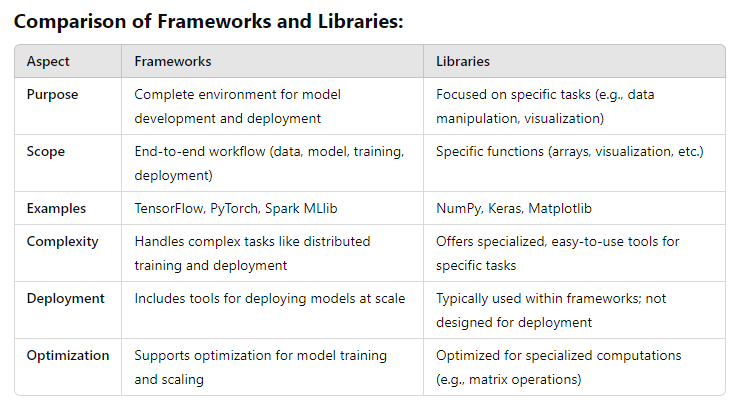
Frameworks : These are comprehensive environments that allow you to design, build, and train machine learning models end-to-end. They include tools for model building, training, evaluation, and deployment, providing a high-level abstraction to manage code and perform optimizations. Examples include TensorFlow , PyTorch , and Apache Spark MLlib.
Libraries : Libraries are specialized collections of code focused on particular functionalities, such as numerical computations, data manipulation, or data visualization. These libraries work within or alongside frameworks to handle specific tasks like matrix operations or generating plots. Examples include NumPy , Keras , Matplotlib , and Spark MLlib.
How These Libraries and Frameworks Complement Each Other
TensorFlow and PyTorch serve as the foundational frameworks for building, training, and deploying machine learning models. They handle the heavy lifting of model development.
Keras simplifies deep learning tasks by providing a high-level API on top of TensorFlow.
Spark MLlib focuses on distributed machine learning for large-scale data processing.
NumPy serves as the backbone for numerical computations and data manipulation, playing a critical role in data preprocessing.
Matplotlib complements these tools by offering a way to visualize data, model training progress, and results.
Together, these frameworks and libraries provide a comprehensive ecosystem for machine learning, allowing