Tools:Kubeflow vs MLFlow vs AWS vs Azure vs Google
Tools:Kubeflow vs MLFlow vs AWS vs Azure vs Google
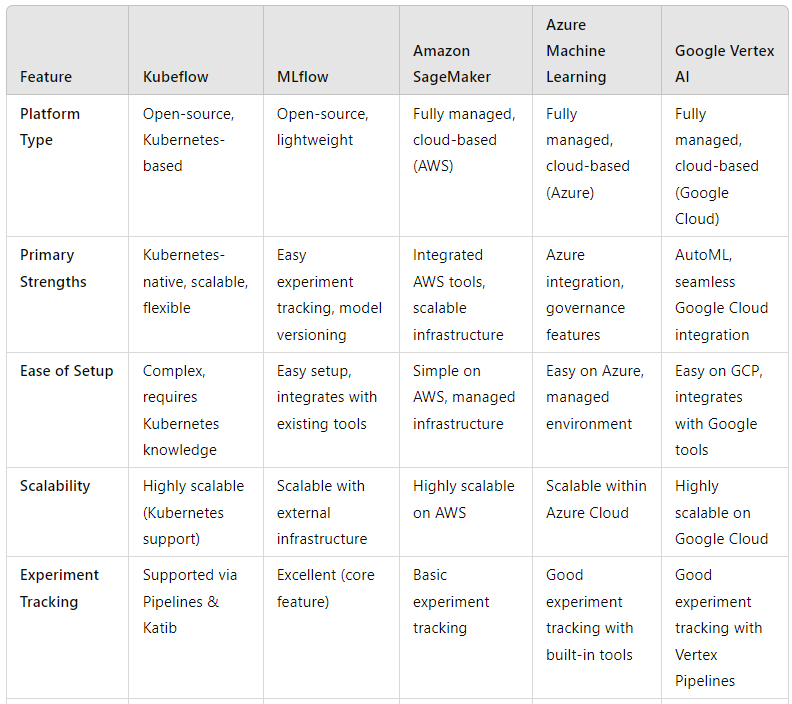
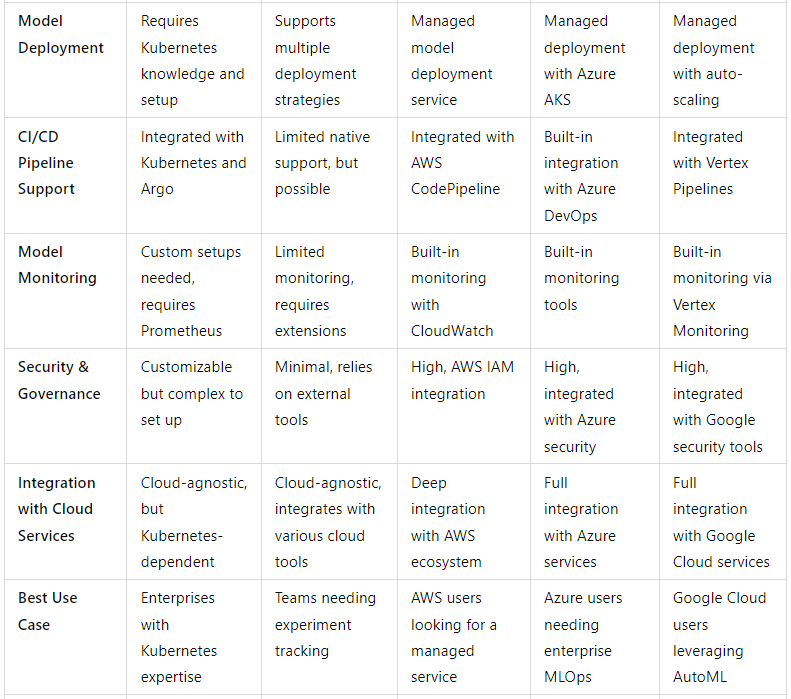
There are various tools and platforms that enable MLOps (Machine Learning Operations), helping teams automate, scale, and manage machine learning models throughout their lifecycle. These tools offer capabilities ranging from model versioning and monitoring to CI/CD pipelines for models. Below is a comparison of several popular MLOps tools:
1. Kubeflow
Description : Kubeflow is an open-source MLOps platform built on Kubernetes. It is designed to automate the deployment, monitoring, and scaling of machine learning models using containerized applications.
Strengths : Native support for Kubernetes, flexible, open-source, scalable for cloud environments.
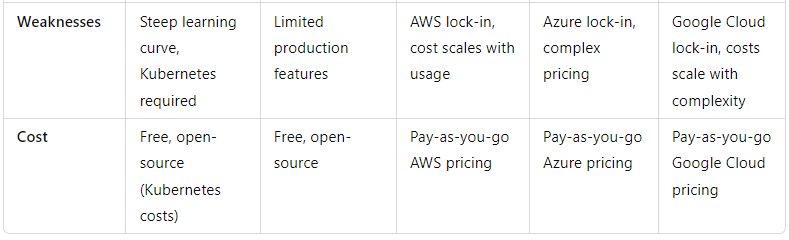
Weaknesses : Steep learning curve, requires Kubernetes knowledge, and can be complex to set up.
Best Use Case : Large enterprises using Kubernetes for deployment who want full customization and scalability.
2. MLflow
Description : MLflow is an open-source platform that helps manage the ML lifecycle, including experimentation, reproducibility, and deployment. It provides tools for tracking experiments, packaging models, and managing models in production.
Strengths : Easy to integrate with existing ML frameworks (e.g., TensorFlow, PyTorch), experiment tracking, model registry.
Weaknesses : Limited support for production features like monitoring and scaling; additional setup needed for advanced workflows.
Best Use Case : Teams that prioritize experimentation tracking and model versioning with a simple setup.
3. Amazon SageMaker
Description : Amazon SageMaker is a fully managed machine learning service provided by AWS. It offers a complete MLOps toolset, including data preparation, model training, model deployment, and monitoring.
Strengths : Full integration with AWS services, managed infrastructure, highly scalable, built-in monitoring and versioning.
Weaknesses : AWS ecosystem lock-in, cost can grow as the scale increases.
Best Use Case : Organizations using AWS who want a managed, scalable MLOps platform without much setup.
4. Azure Machine Learning
Description : Azure Machine Learning is Microsoft's cloud-based MLOps platform. It provides tools for data preparation, model training, model deployment, and monitoring, along with tight integration with Azure DevOps and other Azure services.
Strengths : Seamless integration with Azure cloud and DevOps tools, managed service, strong support for collaboration and governance.
Weaknesses : Azure ecosystem lock-in, pricing complexity, and cost increases with usage.
Best Use Case : Organizations using the Microsoft Azure cloud stack who need a managed solution with enterprise governance and security features.
5. Google Vertex AI
Description : Google Vertex AI is Google's managed MLOps platform, combining AI tools from Google Cloud with MLOps workflows. It offers model training, serving, and monitoring, with deep integration into Google Cloud services like BigQuery and TensorFlow.
Strengths : Google Cloud integration, built-in support for AutoML, seamless support for large-scale model training and deployment.
Weaknesses : Google Cloud ecosystem lock-in, cost scales with complexity.
Best Use Case : Teams deeply invested in Google Cloud and TensorFlow who want to leverage Google's AI expertise for ML lifecycle management.