LangChain
LangChain
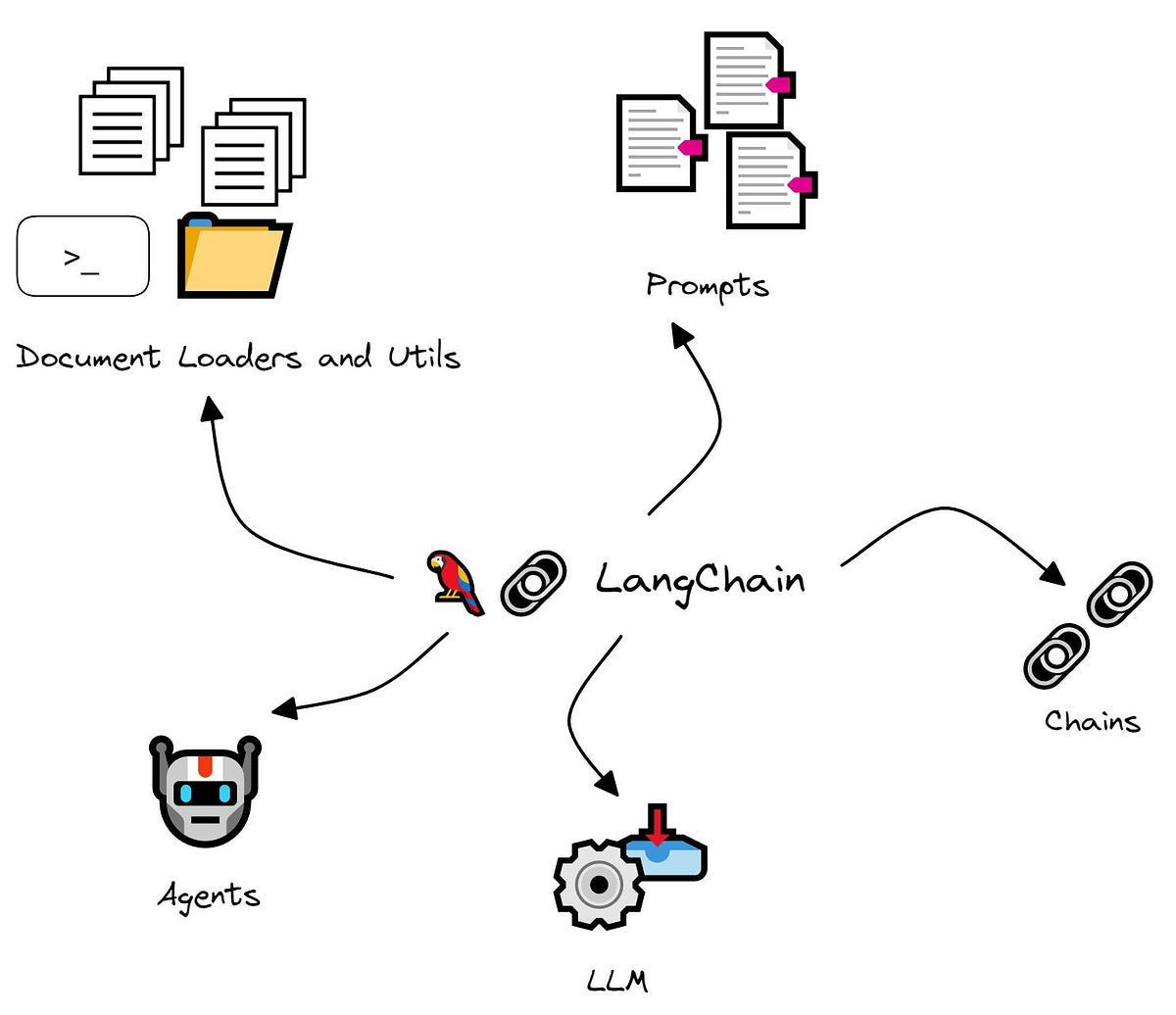
LangChain is a framework designed to build applications powered by large language models (LLMs). It provides a structured way to integrate AI models with various data sources, external tools, and workflows, making it easier to create conversational AI, autonomous agents, and retrieval-augmented generation (RAG) applications.
Key Features of LangChain
1. Components
LangChain provides modular components that can be used independently or together:
LLMs : Interface to various models like OpenAI, Hugging Face, and more.
Prompts : Helps structure input queries to get better responses.
Memory : Stores conversational history for context-aware interactions.
Chains : Connect multiple LLM calls to create multi-step workflows.
Agents : Enable AI to dynamically select and use tools.
Retrieval : Fetch relevant data from external sources.
2. Chains
Chains allow you to sequence multiple steps together. Instead of a single LLM call, you can combine data retrieval, processing, and response generation into a pipeline. Examples include:
Simple chains : A single prompt-response interaction.
Sequential chains : Multiple LLM calls or tool uses in a sequence.
Custom chains : Define workflows using Python functions.
3. Agents
Agents in LangChain enable LLMs to interact with external tools dynamically. They can:
Use APIs , databases, or web search to fetch real-time information.
Make decisions based on inputs without predefined steps.
Use tools like Python functions, calculators, or vector databases.
Common agent types:
ReAct Agent : Uses reasoning and action loops.
Self-ask with search : Breaks complex questions into sub-queries.
4. Memory
Memory helps models retain information across multiple interactions. This is essential for chatbots and virtual assistants. LangChain supports:
Short-term memory (stores recent messages).
Long-term memory (uses vector databases like FAISS for persistent storage).
5. Retrieval-Augmented Generation (RAG)
LangChain integrates with vector databases (like FAISS, Pinecone, Weaviate) to store and retrieve relevant documents. This helps:
Enhance AI responses with domain-specific knowledge.
Improve accuracy by fetching relevant data before generating responses.
6. Integrations
LangChain supports multiple platforms and tools, including:
LLMs : OpenAI, Anthropic, Hugging Face, Cohere.
Vector databases : FAISS, Pinecone, ChromaDB.
APIs : Google Search, Wolfram Alpha.
Cloud services : AWS, Azure, Google Cloud.
Use Cases
LangChain is widely used in:
Conversational AI – Chatbots and virtual assistants.
Document Q &A – AI-powered search and knowledge retrieval.
AI Agents – Automating workflows and decision-making.
Code Generation – AI-assisted software development.
Summarization & Translation – Processing large text data.
Example: Simple LangChain Implementation
Here's a basic Python script using LangChain with OpenAI:
from langchain.llms import OpenAI

# Load OpenAI model
llm = OpenAI(model_name="gpt-4", temperature=0.7)

# Generate response
response = llm.predict("What are the benefits of using LangChain?")
print(response)
Conclusion
LangChain is a powerful framework for integrating AI models into applications. With its modular components like Chains, Agents, Memory, and RAG , it simplifies the process of building intelligent and context-aware applications.