What is Performance in AI, ML, and Gen AI?
What is Performance in AI, ML, and Gen AI?
What is Performance in AI, ML, and Gen AI? 🤖🚀
In Artificial Intelligence (AI) , Machine Learning (ML) , and Generative AI (Gen AI) , performance refers to how well an AI model does its job. It’s like checking how accurately or efficiently an AI system can make predictions, complete tasks, or generate results based on the data it has been trained on.
Definition :
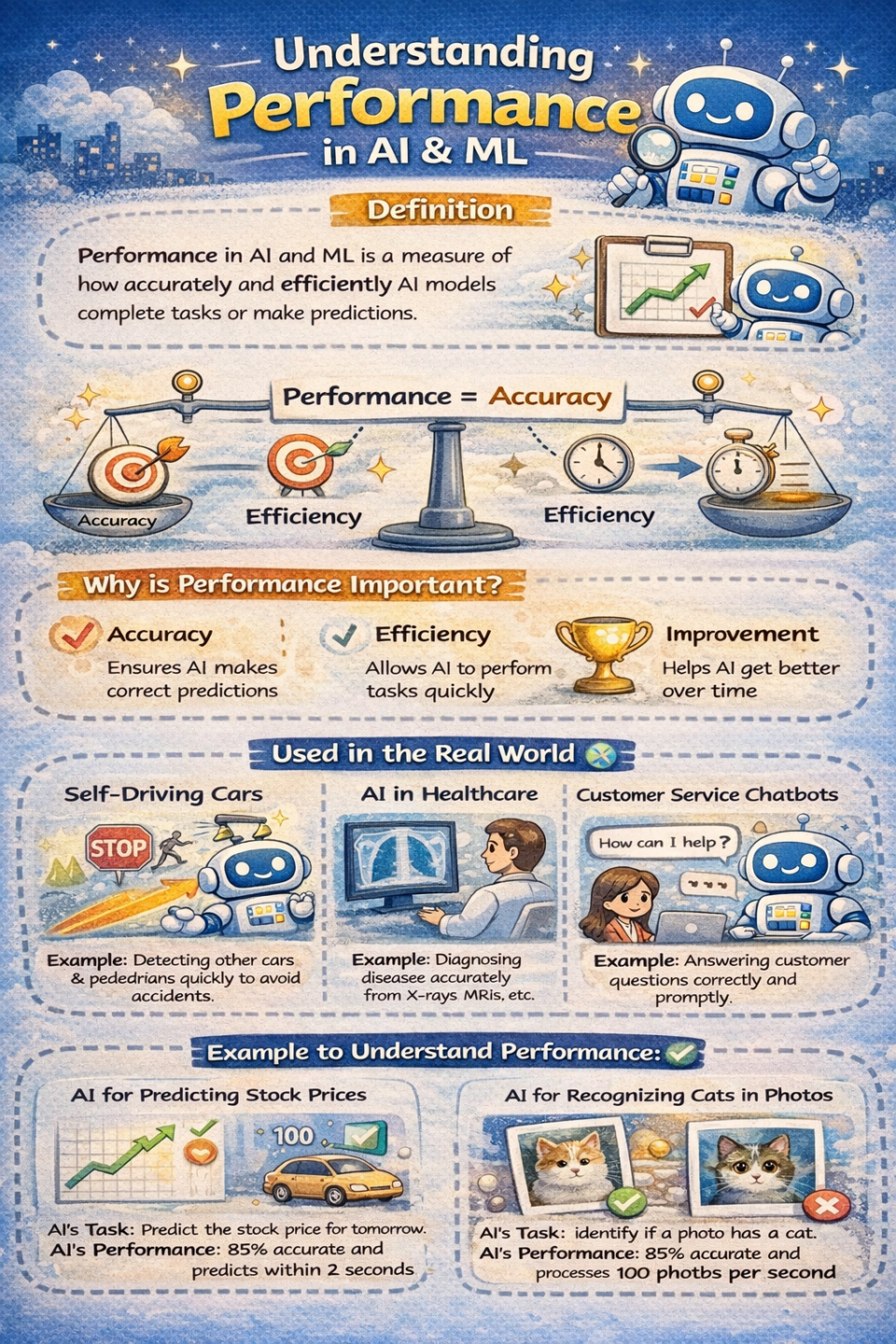
Performance in AI and ML is a measure of how accurately and efficiently the model can solve problems or make predictions. It shows how well the AI can understand patterns in the data and apply them to new, unseen situations.
Why is Performance Important? 🤔
Accuracy : High performance means the AI is accurate in predicting outcomes or classifying data. For example, predicting a house price based on its features or recognizing objects in an image.
Efficiency : Performance also measures how fast the AI can complete tasks. A high-performing AI system can give results quickly , which is important in real-time applications.
Improvement : By tracking performance, we can improve the AI’s capabilities, making it smarter, more accurate, and faster over time.
How is Performance Measured? ⚙️
- Accuracy : This measures how many predictions the AI got right. If it’s 90% accurate, that means it’s correct 9 times out of 10.
Example : An AI model that detects spam emails is tested by checking how many emails it correctly identifies as spam or not.
Precision and Recall : These metrics help measure how specific and sensitive the AI is to certain situations, like identifying true positives and avoiding false positives.
Precision : Out of all the predicted spam emails, how many were actually spam.
Recall : Out of all the real spam emails, how many were correctly identified by the model.
F1-Score : This combines both precision and recall into one score, balancing the importance of both metrics.
Speed : Performance also looks at how quickly the AI model can process data and give results, especially important for real-time applications like chatbots or self-driving cars.
Used in the Real World 🌍
- Self-Driving Cars : In autonomous vehicles , AI performance is critical. The AI needs to be extremely accurate and fast at recognizing objects (like pedestrians or other cars) to make quick decisions for safety.
Example : A car AI must accurately predict the movement of other cars and avoid collisions.
- AI in Healthcare : AI systems are used to diagnose diseases from medical images. The performance of the AI is measured by how accurately it can identify things like cancer cells in X-rays or MRIs.
Example : An AI used to detect tumors in medical scans is tested by how well it predicts the presence of tumors compared to a doctor’s diagnosis.
- Customer Service Chatbots : AI-powered chatbots are used to answer customer queries. Performance in this case is measured by how well the chatbot can understand the user’s request and provide the correct response.
Example : A chatbot that answers customer questions about product features needs to be accurate and quick to provide a good experience.
Visual Representation :
Performance = Accuracy + Efficiency ⚖️
High Performance ➡ Accurate, Fast, Efficient 🚀
Low Performance ➡ Inaccurate, Slow, Inefficient 🐢
Example to Understand Performance : 💬
AI for Predicting Stock Prices :
AI’s Task : Predict the stock price for tomorrow.
AI’s Performance : The AI predicts stock prices accurately 85% of the time (Accuracy), and it makes the predictions within 2 seconds (Speed).AI for Recognizing Cats in Photos :
AI’s Task : Identify whether a photo contains a cat.
AI’s Performance : The model is 95% accurate, meaning 95 out of 100 cat pictures are correctly identified (Accuracy). It processes 100 photos in 1 second (Efficiency).
Key Takeaways: 📝
Performance in AI and ML measures how well a model predicts or completes tasks.
It involves checking accuracy , speed , and other metrics like precision and recall.
Good performance means the AI is accurate , efficient , and can scale well with more data.
In summary, performance is the grade of an AI system, showing how well it performs tasks like predicting outcomes or recognizing patterns. The higher the performance, the better the AI is at doing its job!