L3: Chunking
L3: Chunking
23:37
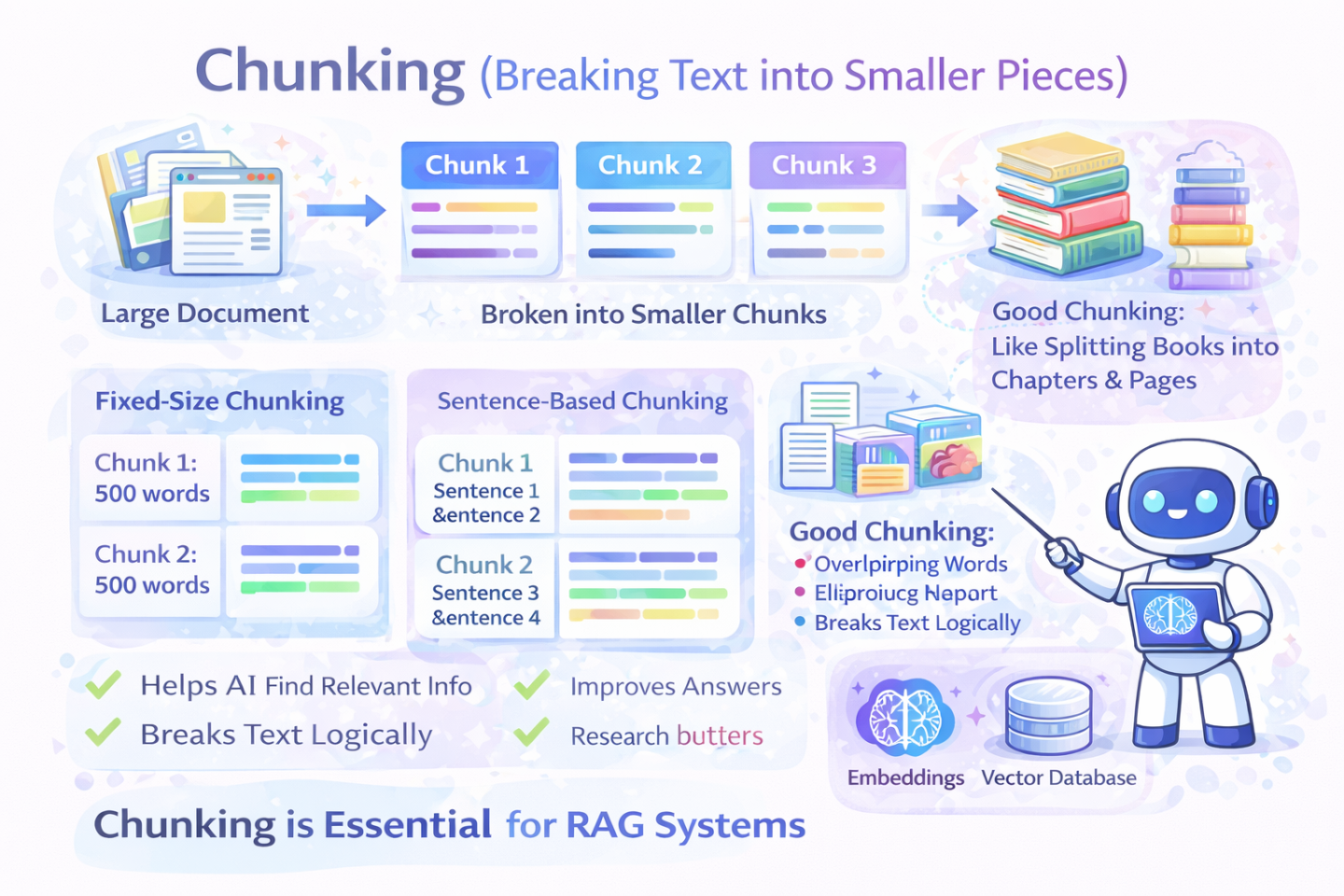
What is Chunking?
Chunking means breaking large text into smaller pieces before giving it to an AI system.
Think of it like this 👇
Instead of asking someone to remember an entire book at once, you give them one paragraph or one page at a time. That’s exactly what chunking does for AI.
Large Language Models (LLMs) cannot handle very large documents at once , so we split the content into smaller, meaningful chunks.
Why Do We Need Chunking?
Chunking is very important in RAG (Retrieval-Augmented Generation) systems.
Without chunking:
AI gets confused
Important information gets missed
Answers become inaccurate or irrelevant
With chunking:
AI retrieves only the most relevant part
Responses become accurate and focused
Search becomes faster and smarter
👉 Chunking helps AI find the right answer, not just any answer.
Where is Chunking Used?
Chunking is commonly used in:
🔍 AI Search systems
🤖 Chatbots
📄 Document Q &A
🧠 Enterprise knowledge bases
📚 PDF, Word, and website data processing
Example:
If you upload a 100-page PDF, chunking breaks it into small sections so AI can search and answer questions correctly.
How Chunking Works (Step by Step)
Take a large document (PDF, text, website)
Split it into smaller chunks
(for example: 300 - 500 words each)Convert each chunk into embeddings
Store them in a vector database
During a user query:
Relevant chunks are retrieved
AI generates an answer using only those chunks
Types of Chunking (Beginner Level)
Here are the most common chunking methods:
1. Fixed-Size Chunking
Text is split by a fixed number of words or characters
Example: every 500 words
✅ Simple
❌ May cut sentences in the middle
2. Sentence-Based Chunking
- Text is split by sentences or paragraphs
✅ More natural
✅ Better meaning preservation
3. Overlapping Chunking
- Some words are shared between chunks
Example:
Chunk 1: words 1 - 500
Chunk 2: words 450 - 950
✅ Helps maintain context
✅ Very common in RAG systems
What Happens If Chunking Is Done Poorly?
❌ Too small chunks → Loss of context
❌ Too large chunks → Slow search & poor answers
❌ Random splitting → Confusing responses
Good chunking = balanced size + clear meaning
Chunking in a Simple Real-World Example
Imagine a library 📚
Without chunking → All books mixed together
With chunking → Books → Chapters → Pages
When you ask a question, the librarian gives you the exact page , not the whole book.
That’s chunking in AI.
Key Takeaways
Chunking = breaking large data into smaller, meaningful pieces
Essential for RAG systems
Improves accuracy, speed, and relevance
Works closely with embeddings & vector databases
Bad chunking = bad AI answers