LLM / AI Application Lifecycle
LLM / AI Application Lifecycle
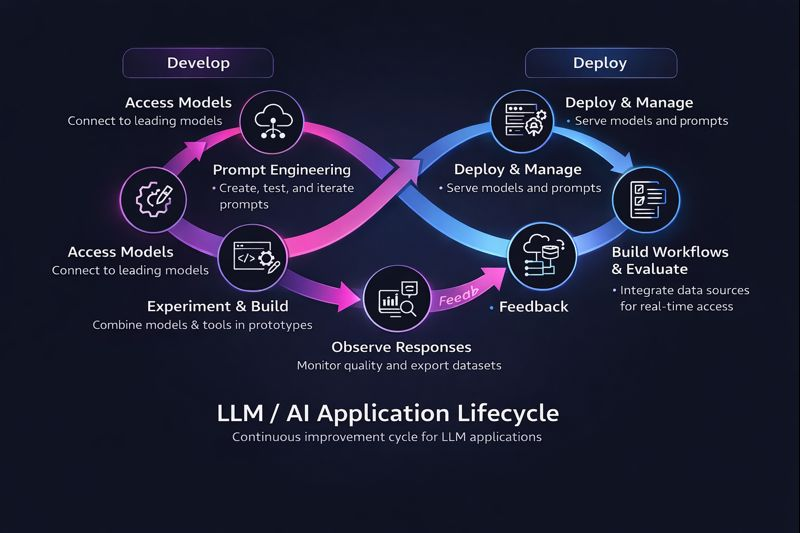
This diagram illustrates the LLM / AI Application Lifecycle as a continuous improvement loop.
It shows how AI systems move from development → production → learning → refinement , rather than following a one-time, linear path.
The infinity (∞) shape emphasizes that feedback from real usage continuously improves the system.
High-level structure
The lifecycle is divided into three logical phases :
1. Develop (Left loop – purple)
Focus: Designing, testing, and iterating AI behavior
2. Deploy (Right loop – blue)
Focus: Running AI systems in production at scale
3. Learn / Feedback (Bottom bridge)
Focus: Measuring outcomes and feeding insights back into development
Step-by-step explanation
🟣 DEVELOP PHASE
1. Access Models
Connect to leading LLM providers or internal models
Abstract away differences between vendors
Enables fast experimentation with multiple models
Purpose: Choose the right intelligence for the task
2. Prompt Engineering
Create, test, and iterate prompts
Compare prompt versions
Optimize for quality, cost, and reliability
Purpose: Shape how the model thinks and responds
3. Experiment & Build
Combine prompts, tools, and logic
Build prototypes and proof-of-concepts
Validate ideas before production
Purpose: Turn prompts into working AI features
4. Observe Responses
Monitor quality, hallucinations, latency, and cost
Collect structured outputs and datasets
Identify failure modes
Purpose: Measure what actually happens, not assumptions
🔵 DEPLOY PHASE
5. Deploy & Manage
Serve prompts and models in production
Handle versioning, traffic, and scaling
Control rollouts and updates safely
Purpose: Make AI reliable and production-ready
6. Build Workflows & Evaluate
Create multi-step workflows and agents
Add tool use, branching logic, and evaluations
Test performance across real-world scenarios
Purpose: Move from single prompts to real systems
7. Build Knowledge Bases / Real-Time Access
Connect AI to:
Vector databases
APIs
SaaS tools
Internal systems
Enable retrieval-augmented generation (RAG)
Purpose: Ground AI in real, up-to-date information
🔁 FEEDBACK LOOP (Bottom bridge)
8. Feedback
Capture user feedback and implicit signals
Track success, failures, and satisfaction
Feed insights back into prompt engineering and experiments
Purpose: Continuous improvement driven by real usage
Key ideas the diagram communicates
✅ AI development is iterative
You don’t “finish” an AI system—you continuously refine it.
✅ Observability is central
Monitoring and evaluation are not optional add-ons; they drive learning.
✅ Production data improves development
Real-world usage is the most valuable training signal.
✅ Prompts, workflows, and data evolve together
Models alone are not the system—the orchestration around them matters.