Intro & History of AI, ML, Gen AI, & Agentic AI
Intro & History of AI, ML, Gen AI, & Agentic AI
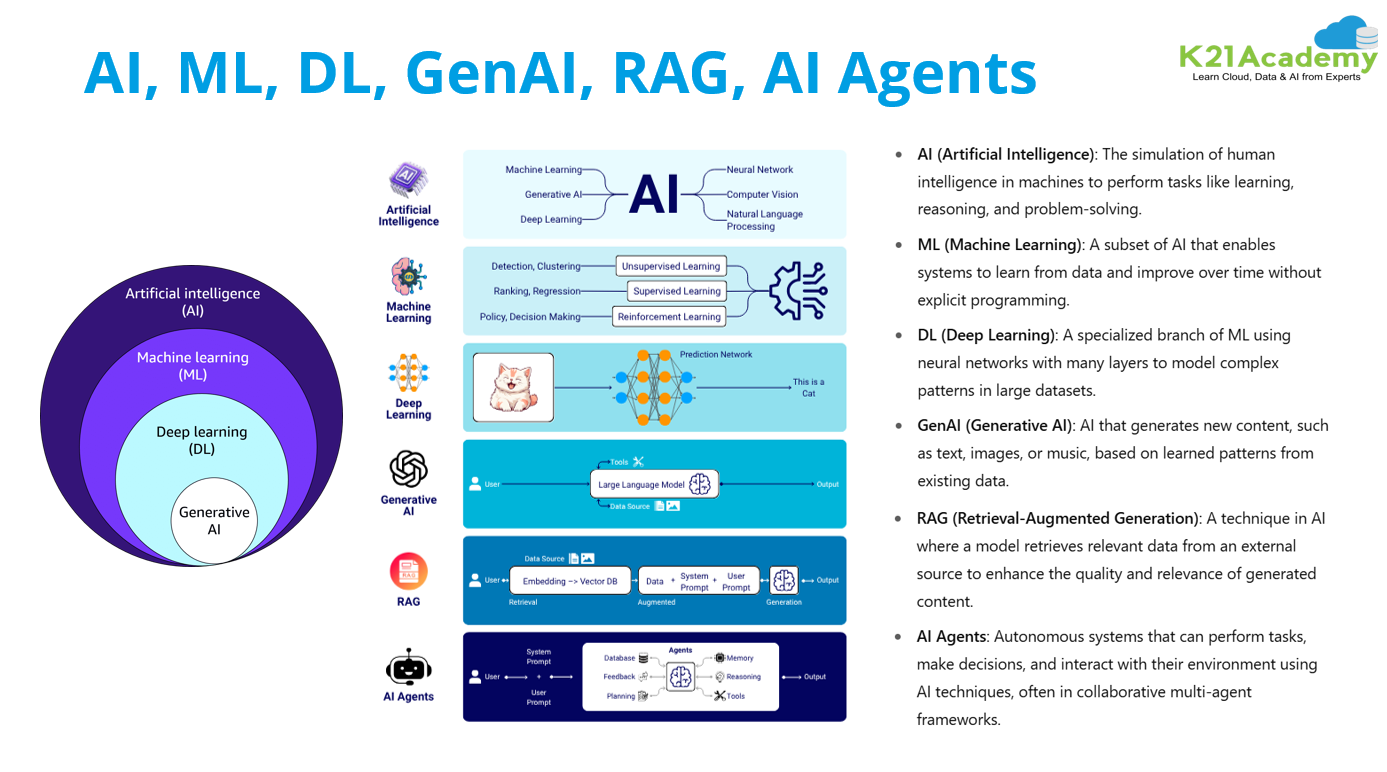
1. Introduction to AI, ML, Gen AI & Agentic AI
What is Artificial Intelligence (AI)?
Artificial Intelligence (AI) means making machines smart so they can perform tasks that normally require human intelligence.
Examples:
Understanding language (ChatGPT, Alexa)
Recognizing faces (Face Unlock)
Making decisions (recommendations on Netflix, Amazon)
👉 In simple words:
AI = Making computers think and act like humans
What is Machine Learning (ML)?
Machine Learning is a subset of AI.
Instead of telling the computer exact rules , we give it data , and it learns patterns on its own.
Example:
Email spam detection
Price prediction
Fraud detection
👉 Simple definition:
ML = Machines learn from data instead of fixed rules
What is Deep Learning (DL)?
Deep Learning is a subset of Machine Learning.
It uses something called Neural Networks , inspired by the human brain.
Deep Learning is very powerful and is used when:
Data is huge
Problems are complex
Examples:
Image recognition
Voice assistants
Self-driving cars
👉 Simple definition:
DL = ML that uses neural networks to solve complex problems
What is Generative AI (Gen AI)?
Generative AI is a type of AI that can create new content , not just analyze data.
It can generate:
Text (ChatGPT)
Images (DALL·E, Midjourney)
Code (GitHub Copilot)
Videos and music
👉 Simple definition:
Gen AI = AI that creates new content like humans
What is Agentic AI?
Agentic AI is advanced AI that can think, plan, and act on its own to achieve goals.
Agentic AI systems:
Decide what to do next
Use tools
Take actions
Learn from feedback
Examples:
AI agents booking flights automatically
Autonomous robots
Multi-step AI workflows
👉 Simple definition:
Agentic AI = AI that acts independently to achieve goals
2. Short History & Evolution
Understanding history helps reduce fear and confusion.
🔹 Phase 1: Rule-Based AI (1950s - 1990s)
AI followed hard-coded rules
No learning
Example: “If this → then that”
Problem:
❌ Could not handle new situations
🔹 Phase 2: Machine Learning Era (2000 - 2010)
AI started learning from data
Predictions improved
Used statistics and algorithms
Example:
Recommendation systems
Fraud detection
🔹 Phase 3: Deep Learning Boom (2010 - 2018)
Neural networks became powerful
Huge data + GPUs helped
AI became much more accurate
Example:
Image recognition
Speech recognition
🔹 Phase 4: Generative AI (2020 - Present)
AI started creating content
Large Language Models (LLMs) appeared
ChatGPT, DALL·E became popular
🔹 Phase 5: Agentic AI (Now & Future)
AI systems can plan, decide, and act
Multi-agent systems
AI workflows with tools and memory
3. Real-World Applications & Industry Use Cases
🏥 Healthcare
Disease prediction
Medical image analysis
AI assistants for doctors
🏦 Finance
Fraud detection
Credit scoring
Algorithmic trading
🛒 Retail & E-commerce
Product recommendations
Chatbots
Demand forecasting
🚗 Autonomous Systems
Self-driving cars
Drones
Robotics
🏢 Enterprises & IT
AI agents for automation
Document analysis
Customer support chatbots
🎓 Education
Personalized learning
AI tutors
Content generation
4. Difference Between AI, ML, DL, Gen AI & Agentic AI
TermWhat it Means (Simple)ExampleAISmart machinesGoogle MapsMLLearn from dataSpam filterDLNeural networksFace recognitionGen AICreate contentChatGPTAgentic AIActs independentlyAI agents
👉 Easy way to remember:
AI → Thinks
ML → Learns
DL → Learns deeply
Gen AI → Creates
Agentic AI → Acts
5. Why This Matters for Beginners
You don’t need math to start
You don’t need coding initially
Understanding concepts first is critical
Tools change, concepts remain forever
Lesson Summary
AI is the big umbrella
ML and DL help AI learn
Gen AI creates content
Agentic AI acts autonomously
AI evolution is continuous, not one-time
**Check out the PPT here >>> ** Introduction to AI / ML/ Gen AI & Agentic AI
Please perform the Quiz to evaluate your learning:CLICK HERE
Resources
AI for beginners: Guide