Top-p
Top-p
What is Top-p in AI, ML, and Gen AI? 🤖💡
In Artificial Intelligence (AI) , Machine Learning (ML) , and Generative AI (Gen AI) , Top-p is a method used to control the randomness and creativity of the AI's responses, specifically when generating text. It helps the AI decide which words to choose based on their probability, ensuring the output makes sense while adding variety and creativity.
Definition :
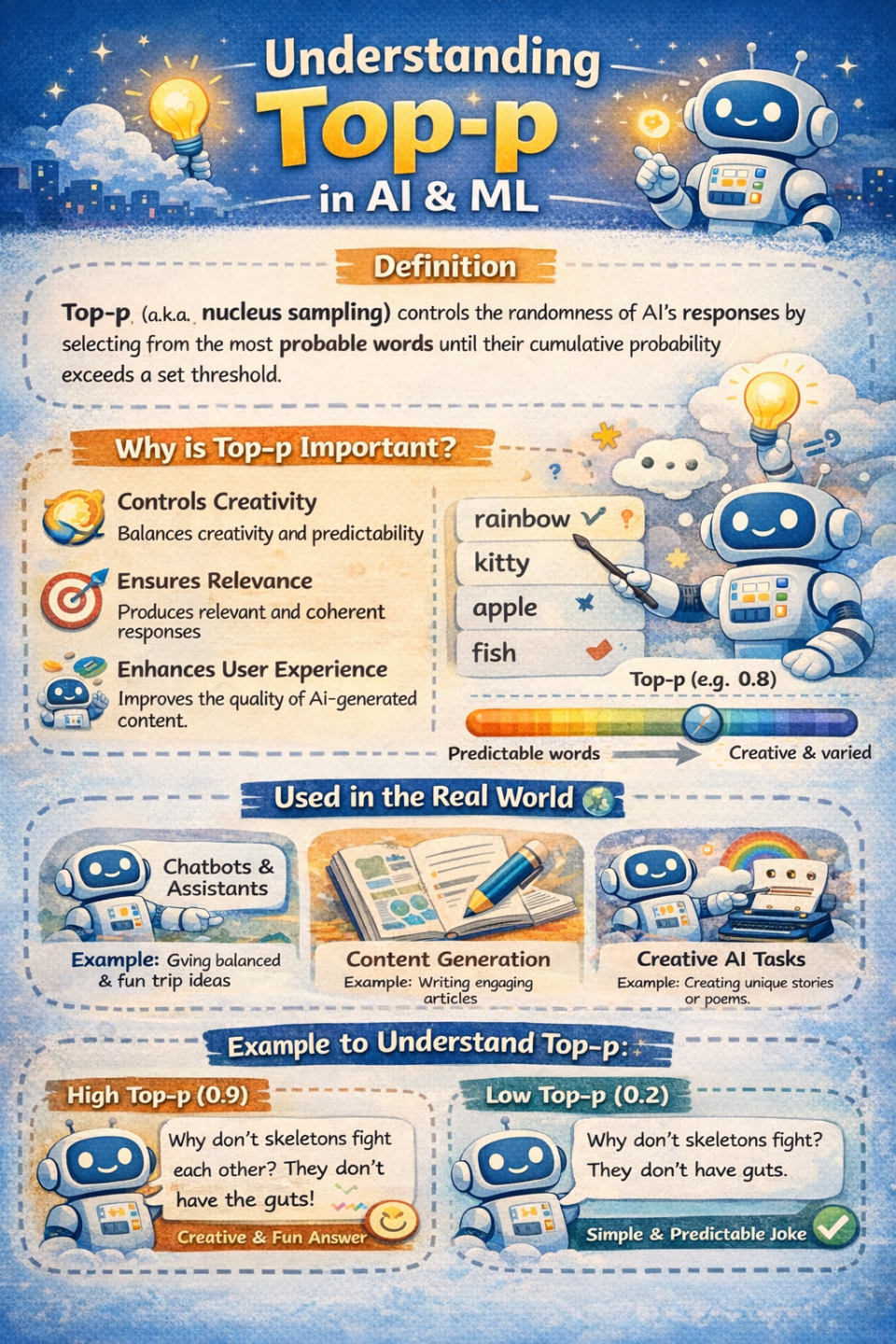
Top-p , also known as nucleus sampling , is a technique used in AI models to pick the most likely next word from a set of possible options. It works by choosing the smallest set of words whose cumulative probability is greater than a threshold p. This makes the model more focused and balanced, ensuring the results are diverse but not too random.
Why is Top-p Important? 🤔
Controls Creativity : Top-p helps manage the level of randomness in the AI's response. It allows the AI to balance between being too creative (which might produce nonsense) and too predictable (which might be boring).
Ensures Relevance : By focusing on the most likely next words, Top-p helps the AI generate responses that are more relevant and coherent , while still allowing for diversity in output.
Enhances User Experience : It improves the quality of AI-generated content, whether it’s for chatbots, content creation, or other tasks, making the responses feel more natural and engaging.
How Does Top-p Work? ⚙️
Probability Threshold : The model first calculates the probability for all possible next words. It then ranks them and keeps selecting the most probable words until their combined probability reaches p.
Value of p :
A high p value (close to 1) means the model considers many possible words, leading to more creative and varied responses.
A low p value (close to 0) means the model will only choose from the most likely words, leading to more predictable and structured responses.
Used in the Real World 🌍
- Chatbots and Virtual Assistants : Top-p can be used to create more engaging conversations , ensuring the AI gives you creative responses while still staying on topic.
Example : A chatbot helping you plan a trip might give you interesting ideas, but it won’t suggest things that don’t make sense, like traveling to the moon.
- Content Generation : In writing or generating articles, Top-p ensures the AI doesn’t repeat itself or generate strange, irrelevant sentences while still offering variety in the writing.
Example : Writing an article about "Healthy Eating" without repeating the same ideas over and over, yet adding new suggestions.
- Creative AI Tasks : For generating poems, stories, or other creative content, Top-p allows the AI to introduce creativity without losing coherence.
Example : Generating a poem that’s unique and artistic, yet still makes sense when you read it.
Visual Representation :
High p Value ➡ More Creativity and Variety 🌈
Low p Value ➡ More Predictability and Structure 📚
Example to Understand Top-p : 💬
High Top-p (0.9) :
Question : "Tell me a joke!"
AI's Response : "Why don’t skeletons fight each other? They don’t have the guts!"
(A creative and fun answer)Low Top-p (0.2) :
Question : "Tell me a joke!"
AI's Response : "Why don't skeletons fight? They don’t have guts."
(A simpler, more predictable joke)
Key Takeaways: 📝
Top-p controls the creativity and predictability of AI’s responses.
It allows the model to focus on a set of probable words , adding variety without going too random.
Higher p gives more creative, diverse outputs , while lower p ensures more focused and structured responses.
In summary, Top-p is a handy tool in AI that helps balance creativity and accuracy, making sure that the AI's responses are interesting but still make sense!